Monday, 29 June 2015

How Motion Pictures Work

Back in February (as a duty of editor of the NAS Times newsletter) I took part in a group that visited various places in Glasgow.
On our first trip that month we went to the Mitchell Library. At the time of our visit, it was holding an exhibition about cinemas in the city. Glasgow had a lot of cinemas. In fact, in the 1930s Glasgow had more cinemas per head of population than any other city in the world.

It was after seeing this exhibition (which showed a few old projectors and various other pieces of cinema paraphernalia) that I thought about making another informative strip (like the one I did back in November).

I didn't chase this idea until just a few weeks ago when I was in the mist of making this animation.

The subject of this strip is motions pictures. As someone who loves animation, I'm fascinated how it is possible for drawings, models or photographs to become "alive" on screen. Its a very interesting thing to investigate. It involves biology as well as technology. Reading about how movies were invented is a very interesting story, involving many characters, especially Eadweard Muybridge, and mysteries, like the disappearance of Louis Le Prince. I might one day do something about this, but for now here's how motion pictures work....

Featuring The Masked Pidgeotto.


Took a bit longer than expected to make.

UPDATE: June 2017

Last night I wrote this paragraph. I think its does a better job than this strip...

“The Illusion of Life”
Human vision has the sense rate of about one tenth of a second. This means that if an object travelling across a human’s field of vision takes less than one tenth of a second to do so the eye won’t see it. If an invisible person moved an object in small intervals in that field of vision, if those movements happened in a rate more than ten times a second, it’ll appear to the eye that the moving object is “alive.” The same thing happens with still images. If you flash still images into someone’s field of vision at least 12 times a second (with some mechanism to block the image briefly as it changes to the next one) they will appear to move. But the more images you flash a second the smoother the movement appears to the eye, as the blank spaces between images become less noticeable. According to Thomas Edison, the ideal minimum rate for “flicker-free” movies is 46 images per second - "Anything less will strain the eye." 

It demonstrates what I am trying to do with my computer book.

Monday, 22 June 2015

A surprise appearance of Kai Hiwatari

Just recently (when browsing this month's copy of MyM that I bought from Forbidden Planet) I was taken aback when I instantly saw this page....

from page 6 MyM Issue 39 (June 2015)

Regular readers of this blog will know that I have a sort of.... fraternization with this particular character. So much so that he occasionally makes an appearance in this blog. It's the result of research I did for a proposed piece of fan-fiction which I talked about (a bit) back in March.

Reading the article, I'm intrigued that Paramount Pictures is planning to make a live-action movie for the franchise (and the fact that these spinning tops has made $2.5billion!).

I can pretty guess that the resulting film will involve a lot of colour-filtered CGi, as (despite the existence of real-life remote controlled tops) its nearly impossible to control the direction of a top. It's like taming a cat.

My final thought about the idea - I think it would be as successful as the live-action Dragonball movie.

Good luck Paramount, because your gonna need it!

Act of Cultural Vandalism - The Art of the Ident - The Legacy of Channel 4


Some time a few months ago I discovered this documentary made by a You-tuber called Applemask (real name Matthew Harris). His YouTube Channel is one of those channels that is mostly made of old TV ads, trailers and idents. But, unlike most of them, its creator has some attitude. If I was doing my own act of cultural vandalism on the history of Channel 4 idents, this is what it would look like. He's ready done the work.

4Sight: The Changing Face of Four (2012)

After finding this, I decided to do this mini act covering a brief history of the TV ident. They are more comprehensive histories out there on the net, if you want more details. Its the sort of geeky thing the net was made for. I can't imagine a book been made about this subject. Idents are mini moving pictures. And (as anyone who has tried to explain "bullet-time" to someone who has never seen The Matrix can tell you) moving pictures are much harder to describe in words than still images.

Please note that I'm assuming that most of the world's TV channel branding followed a similar development to the UK's (which I know a lot about), so sorry in advance for the accidental bias.

Until the 1980s most TV channels branded themselves with just their logo and a voice-over saying something like"This is CBS." Much of them usually used visual memes that reflected the national identity of the channel's audience. But a number of them did a more flare, by animating the graphics on screen. Rotation seems to be a common meme in these idents.

WABD ident (1948)

NBC ident (1949)

BBC "Bat Wings" ident (1953)

Scottish TV ident (1957)

Anglia TV ident (1959-88)

ABC ident (1960s)

ABC ident (1960)

CBS ident (1967-9)

The introduction of colour didn't change much...


ATV colour ident (1969-81)


It is worth noting that many of the more animated ones were made using mechanical mechanisms.

Thames TV logo been operated by character from Camberwick Green

More artistic flare could be seen in the things shown during sign-on and sign-off of the station (this was before 24-hour broadcasting, remember). It's in these you'll find the most patriotic of TV graphics, such as the country's flag.

Channel 3 Closedown (1983)

TVB Closedown (1987)

The most artistic I have ever encountered (by chance) was this sign-on/off from Japan....

Hato no kyujitsu (Dove's Day Off) 
Nippon Television's sign on/off ident (1953-2001)

Apart from these, most TV channel branding was... well, boring. Even with the introduction of computer graphics in the 1970s didn't change much....


Ident history of Globo (1977-99)

OECA ident (1975)

That was until November 1982, when this appeared on UK TV screens...

Hamlet Cigar Ad parody of Channel 4 ident (1984)

Sorry, wrong clip. This appeared on UK TV screens....

Channel 4 ident (1982)

This ident was a massive game-changer in television graphics design. It wasn't because it was a first in the history of computer graphics (as shown before, computer-generated idents have been used for years on TV way before 1982).
What is significant about Channel 4's ident was it was just one facet of something bigger - the branding of an entire TV channel. Until then, their was nearly no design consistency throughout a channel's own graphic design. The sign-on/off and the captions used to tell what was on were only matching in what fonts and colours were used. And it gets worse when you consider the seasonal decorations they do during holidays, such as Christmas. 

These graphics from BBC 1 in the mid-1970s are typical of what I'm talking about.


BBC 1 graphics from 1975-7

You see, no true design consistency, especially the Christmas one. 

Martin Lambie-Narin's work for Channel 4 changed all that. Although (to begin with) everyone else didn't exactly "get it." Everyone else thought it was the use of CGi that was key to this success. This resulted in a rush for many broadcasters to create their own computer-generated idents....

BBC 1 "COW" ident (1985)


LWT logo (1983-6)

TSW ident (1982-5)


Scottish TV ident (1986)

Eventually (through Lambie-Narin's later work and the increase of TV channels brought on by developments in satellite and cable services) other channels finally got what he had done to Channel 4 and followed suit. Lambie-Narin himself helped sort out the BBC's own identity in the 1990s, beginning with the idents for 1 and (especially) 2, eventually doing over the whole organization

The creation of the 90s "2s"from
How Do They Do That? (BBC 1,1995)

For those who haven't exactly worked out why Lambie-Narin's a genius, note what Alan Yentob said about the previous BBC 2 ident, the boring "TWO." 
"I realised there was a problem almost as soon as I took over the channel [BBC 2]. It was obvious that the logo made absolutely no impact. In fact, it was something anyone could have told you. It was singularly unmemorable, and told you nothing about the personality of the channel." - Alan Yentob
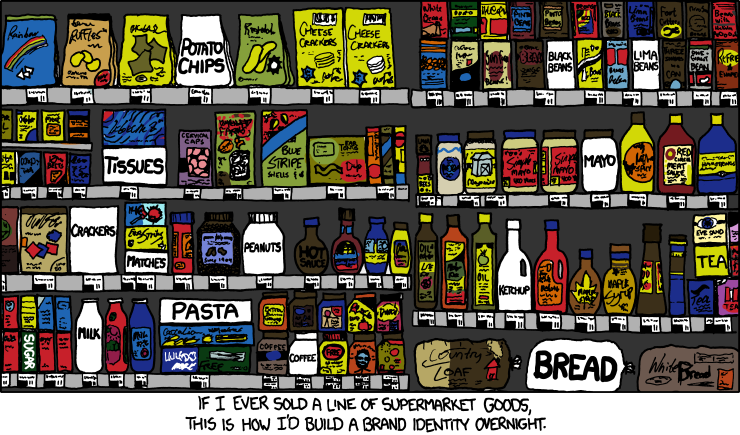
The reason Lambie-Narin's Channel 4 ident worked because it stood out. Let me describe this impact with an analogy. Imagine you are in a supermarket browsing the shelves. The products on the shelves are TV channels and your eye movements from one product to an other is you pressing buttons on the remote. 


Until Lambie-Narin's blocky 4, TV channel idents were like the design of packaging used on supermarket own-brand stuff. They don't "shout out" to tell you who or what they are. Imagine an aisle full of own-brand stuff. It would be a very dull site. That blocky 4 was the first introduction of eye-catching branding in that aisle. Ironically, to have the same impact today, you have to do the reverse....

"Brand Identity" xkcd (21th December 2011)

This web comic strip also illustrates another thing that affected Channel 4's impact at the time - the increase of channels. The boring branding of the past worked fine when their was few TV channels (The UK only had three until Channel 4 came along (duh)). But with more channels coming on air that supermarket shelf in channels that boring branding couldn't work any more. Channels needed to stand out from the crowd. And that was Lambie-Narin's big idea. To grab viewers attention, TV channels needed to brand themselves like washing powder. 

Today, every channel on TV around the world has (in some form) an instinctive visual brand. You'll see it every time you change channel between shows. And that is Channel 4's legacy.

One final note; in the end of his documentary, Harris made a prediction that the next redesign of the Channel 4 logo will involve coloured blocks. Have you seen the recent ads about Channel 4's on-demand service?
Introducing All 4 ad (2015)
I know this isn't technically an "ident," but it is regularly-used graphic on the channel, so it counts as an ident to me.

And another note; the animation at the start of this post is the first piece of animation I have made in three years. I had plans for many cooking up in my mind during that time, but it is only now I finally developed the willpower to do it. So, watch out! More may be coming soon (but don't hold your breath. This isn't a regular service.)

UPDATE: On September 29th 2015 Channel 4 finally changed its idents... into something very bold and kind of unique... and unexpecting (except if your Applemask).

Channel 4's new idents (2015)

Sunday, 31 May 2015

My New Tablet

My birthday happened recently. Usually (for years) I have been clueless of what I want for my birthday. So the last couple of years, my birthday presents have been surprises (with my ride on a plane in 2013 been the most impressive).

But this year has been different. Since January I had invested a lot of thought on the subject on how I could use my birthday as an excuse to buy something expensive. I am no big spender (I haven't got the cash for that.... let), but I do like to occasionally buy things, like books and DVDs. Cultural things like that. I rarely spend money on clothes. I occasionally spend above £25 on Amazon. You get he picture.
Recently I have noted the usefulness of small tablet computers. My family has been a bit crazy for them in the past few years, buying (probably) half a dozen of them. The very first one they bought (a big Yarvik Android model the size of a notebook) ended up in my procession, because I got addicted to The Simpsons: Tapped Out game. However, I have lost the use of this tablet in March 2014 because the socket you plug in the charger into it got broken. So for over a year I had rarely touched a tablet's screen.
In fact, I had only occasionally did so in spats of activity over the years, as I didn't find them very useful to me... let. This was mostly because their size was an inconvenience and the fact that I'm not that into games and the only reason I was really using them was to play games.

But this year I had a change of heart. By now tablets can come in many sizes and their spec have improved greatly. Also you can now find a good tablet for less than £100 (and I'm not talking about second-hand stuff here.) But the main reason for my change of heart is because I finally worked out uses for one in my life.

So my birthday comes. I get money from relatives. I browse Amazon for a good deal. I found one I liked at a great price. But before I clicked the "buy" button I find that that second-hand tablet had a scratch on the screen. I may have been a minor thing, but I knew my parents would be disappointed in my buying such an damaged device. So instead, last week I went to Currys. I was lucky... it was a bank holiday and they had a sale on. As son as I entered I went tot he tablets and found a device that met my criteria....
For around £130 I bought (along with a leather case, a stylus, a screen protector, anti-virus software and 200GB of cloud storage) this....

My new Samsung Galaxy Tab 4

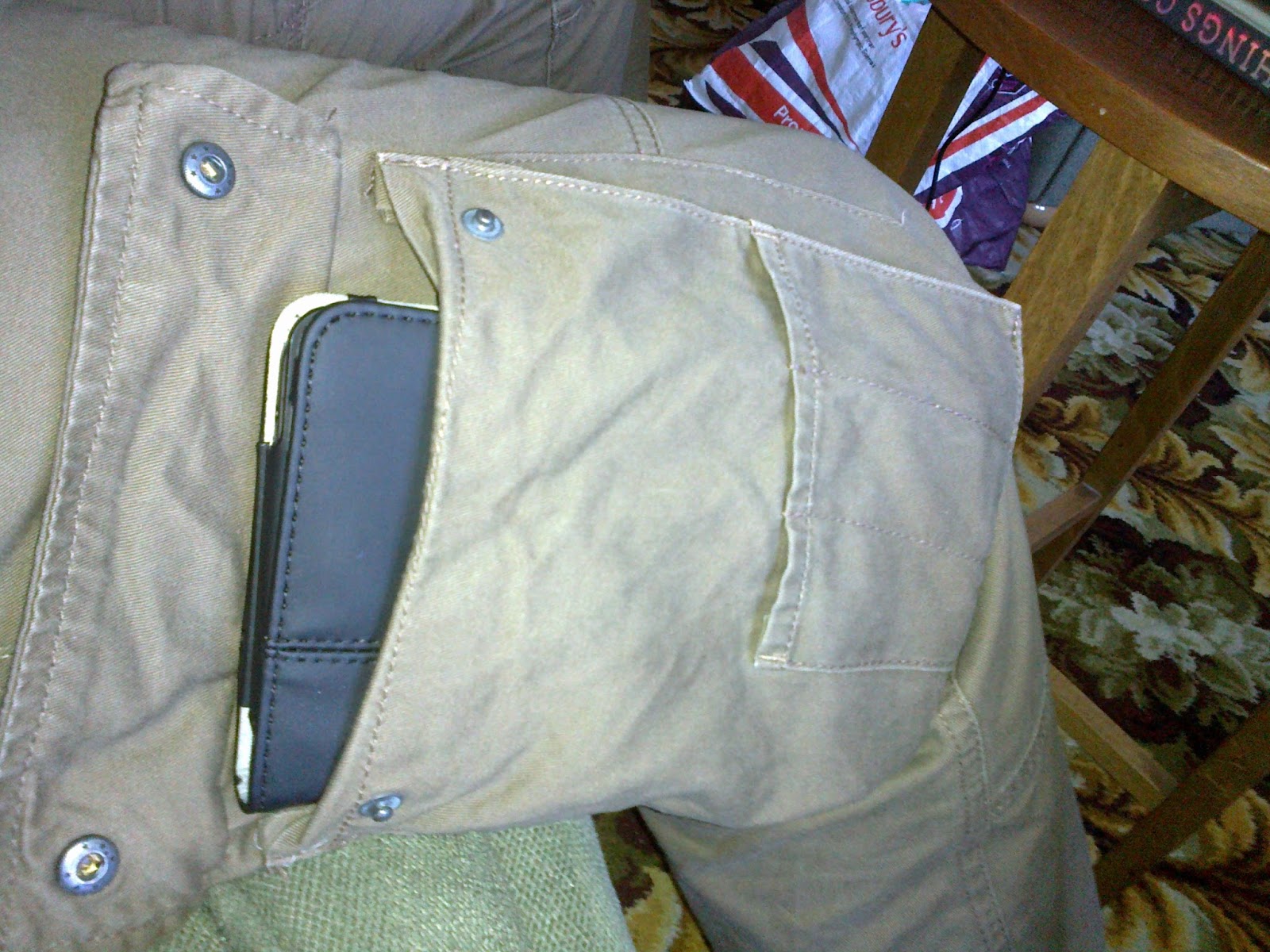
A black, 7-in screen Samsung Galaxy Tab 4. I have used this device every day since I bought it. I have used it to revisit my Springfield that I have abandoned back in March 2014, watch YouTube videos, listen to music and draw a few pictures, like the one above. And I made sure it was very portable. I choose a 7-in model because it was small enough to fit inside the knee pockets of my several pairs of cargo trousers

My new tablet (plus case) in pocket

You have to agree that this is very convenient (but it can be a tiny bit awkward while walking). 
But it is also big enough for the task of drawing with ease. It's the perfect size.

With this device I can quickly note or draw things down while on the move without the hassle of getting out an A4 sketchpad from a bag or briefcase. 

I could have posted this earlier, but its only today that I got a stylus specialized for drawing (which I used to redraw my profile picture in the photo above). 

Best (self-bought) present ever...

Hey, no one else knows my needs for a tablet (like the cargo trouser pocket dimensions). They could have bought me something that was too big for my needs or something rubbish made in China.
You know what I mean....

Saturday, 16 May 2015

A PowerPoint for school: Pokémon by Joshua Wallace (With some assistance from Uncle Gordon) (May 2015)

Recently my nephew was given the task to do a 3-minute talk on any subject he liked for school. 

The topic he chose to do was Pokémon

Yes, everyone over-20, Pokémon is still alive and kicking.

A week before the day of the talk, I was approached by my mother and him to help with his research and make a presentation for him. I made a list of facts he could talk about, had it proof-read and edited to make it easier for him to read and say and made the following PowerPoint presentation...

A simple title card to start off with.

One fact we thought the kids should know is that Pokémon has a creator and 
his childhood hobby was his inspiration for the franchise.
The choice to use bug-types for decoration is obvious.
That console is a NES on purpose. 
Porygon is just there to fill in some space.
My nephew really liked my idea of the drawing on this slide.
This is where most of my background knowledge on Pokémon's history was put in.

I chose to use an image from the first series on purpose.
(explanation below next slide)
I'm most proud of this slide. 
Most kids in his class would only know of Pokémon from Black & White onwards. 
But my nephew has been exposed to some of the earlier stuff,
so he knows a few things about Ash's Kanto adventures
My nephew insisted in including the mega-evolved forms of Charizard on this slide,
plus the mega stones. And yes (everyone over-20) they are now 720 of them.
I originally intended to have an explanation of what Pokémon is at the start of the presentation.
But I was overruled on the ground that everyone in his class already knew that.
I was thinking about the teachers when I thought of it, not the kids.

A final statement to end on.

Along with this presentation he bought with him to show to the class a number of relics, including...
My original copy of The Official Pokémon Handbook (1999)

That is my original copy, and here's proof (and proof of transfer of ownership in 2011)


And here's further proof of ownership.

(brightness/contrast altered for easier legibility)

I have since bought a more mint-condition copy for my archive.

My "mint" copy of The Official Pokémon Handbook (1999)

Sorry I've gone off topic there. It's a habit.

So, how did it go for him? 

He said he got "Top Marks". 10 out of 10!
They loved it!

Saturday, 2 May 2015

NEW: Works by Category Page

Just recently, I created a few pages that you can access on you left.

I have felt that I have posted enough material that I thought you may need help finding stuff. Also, I thoguht I could really use this blog as a showcase of my talents in various mediums. That is why (and the fact I just worked out what "pages" are on Blogger) I have made a number of pages listing my various posts by its contents, i.e. Photos, comics strips, posts about ads, fictional book covers, etc. They are all (technically) "works in progress" as in they will change as I post more material.

Look at it anyway, it includes stylish banners I made in Photoshop. Here's one of them (as a taster) which is used to decorate the page dedicated to scientific content.


They also contain a brief intro that explains a bit about my history concerning the particular aspect of my work.

Also, fell free to look at the other links as well, including the recently made "My Drawing Past" page, featuring a selection of drawings I made in the past.

Come on, even the best and greatest of artists had to start somewhere.

Monday, 27 April 2015

Ian Thomson (1947-2015)

At 9:30pm Tuesday 21st April 2015 a dear relative of mine finally passed away. For the past few years the grim reaper had been trying to bash down his front door, but shim finally succeeded smashing through it and began hier work claiming him on Saturday. His final moments were in the care of the nurses in the care home in Meigle (I'm sure its the only one in that village. And I'm sure his spirit will have lingered for a while at the Sculptured Stone Museum, home of one of the finest collections of Pictish carvings in Europe. He would have liked that.).

Ian Thomson (or "Papa Oyibo", as he was called by the Yoruba people in Nigeria) was a senior engineer who's intellect and charm led him to have many adventures in Africa, Asia and the Middle East while at work there. He was a well-travelled man, exploiting his knowledge, skills of storytelling and Scottish charm all over the place. They are many, which I have trouble remembering in exact detail as they were so many. He did write them down in black book, which I have seen him read from (and I hope, is saved from obliteration (more on that later)).

Of all the stories I have heard, one story that I just got reminded of by my mother recently (which, I think, is very relevant now) is how he became "The Man Who Sang." One day in an Islamic country (I don't know which one exactly, but for the sake of the search-bots invisibly crawling over this text let's keep it vague shall we.), Ian sang out loudly from the roof of his hotel the song "The Lord is My Shepard" (I think, I'm not 100% on this (keeping it vague).). Non-surprisingly, he was soon arrested for it. However, while most people would just accept the punishment, Ian argued that he technically didn't break the law on the grounds that the the scripture in question can be found in the Koran, therefore singing it was not an act of blasphemy. He was free in a hour. That night, at one in the morning, he received an alarmed knock at his door. It was from a Christian. He had heard of the story of "The Man Who Sang" and asked him to become their minister (as their previous ministers kept been getting arrested). He turned down the offer been a minister (he was not that religious), but he did meet with the other Christians and taught them (basically) how they can get away with expressing their faith without going to jail by exploiting the fact that the Koran contains many scriptures that originate from the Bible. (It's a history thing not many people realize. DISCLAIMER - I am not a religious scholar, just a casual amateur historian.)

And that's just the tip of a huge iceberg...

By 2000 he had enough life experience and intellect to have talking match against Brian Blessed. I can confirm this as it was by this time that I actually started to know him. By then, he began to write down many stories fictional and biographical.

He did manage to get one story published as a children's book in 2000, which I have a copy of...

Big Brother, Little Sister by Papa Oyibo (2000)
I checked and its on sale on Amazon.

This is one many many short stories he has told and written over the years. However, he hasn't been able to publish them in the traditional money-making sense because...
  1. His ill-health in his later years prevent him from almost all physical work.
  2. Because of this ill-health he was highly dependant of welfare.
  3. If he did try to make any money from publishing his work, he'll lose such welfare.
That is a horrible situation for anyone creative. And that is just the tip of an iceberg of bureaucratic nightmares he had faced in the final decade in his life due to his health and the fact he married an American and nearly routinely crossed the Atlantic. Love knows no boundaries.

But now that he is no longer with us, I am personally worried about the amounts of written material he has left behind (on paper and on digital media). What is going to happen to them? Is some heartless philistinal house clearer going to destroy this material? I would be absolutely angry if someone did this to my collection of drawings and writings. And if this did happen when I died, I will (if it is possible in the afterlife) haunt this guy's house as a poltergeist and  destroy everything he had worked hard to earn or assemble, making him feel what this angry spirit is feeling. I imagine Ian would feel the same way. And I would imagine he would have read what I have just said (though the ether of our Wi-Fi signals and on an iPad (as Steve Jobs has improved the infrastructure) and is thinking of doing just that, now that he has no sick physical body and the law to hold him back (as far as I know the law doesn't apply to ghosts). So if you hear news of a house clearer in Scotland (or anyone working in the DWP) experiencing destructive paranormal activity recently, its a good chance its my Uncle Ian.

To any of his and my family reading this, I can safely assume that Ian would be in fits of laughter reading that last bit. He needed it, after all that bureaucratic headaches he suffered in life.

But I still worry about his creative work. However, I know that a small bit of it is safe, because I have a few bits of it on my hard drive. A few years ago he proposed an idea to make a children's eBook, featuring illustrations by me. I did a few sketches for it, and he gave me a lot of material to work form, including the original text. However, things got in the way (mostly due to his health) and little progress was done. But, I still got all the material, and it should be enough that (if I have the will and time) finish this book (plus a few sequels, if its a success).

My uncle Ian was an inspiration, and I am very saddened that he is gone.

This picture was taken in 2010.
Later images don't do him justice due to his ill health.