Showing posts with label 1974. Show all posts

Thursday, 9 April 2015

Is This Probably The Best Beer Ad in the World?

Mock-up of Carlsberg Free Beer Dispensing Billboard (2015)

On 8th April 2015near to the Old Truman Bewery in Shoreditch, London, Carlsberg (the beer that claims to be "probably the best beer in the world") set up what is probably the best beer poster in the world - a poster that gives out FREE BEER!

Yes, Carlsberg made a billborad that gives out free beer. 

I know. It sounds like something from the 20th century (maybe 1970s America?), but this has happened. A brewer has done a publicity campaign giving out free beer. Carlsberg must have a lot of balls, doing this in a time when the very idea sounds like (to a notable percentage of the population) the anti-smoking ad giving away free cigarettes I made last year. But, so far, I have heard no news of  large drunken riots in London.

Carlsberg do plan to roll this out across the UK. Is this a good idea? I don't know, considering the British's reputation when it comes to drink. I bet the usual people (The Salvation Army, the AA (and the other AA as well), etc) will protest this in the usual reactionary way, but I don't think it'll do anything. In fact (judging from the history books), it will make more people drink from the billboard.

So, people who are appalled by the idea who want to protest - don't protest. It'll make things worse! One of the lessons from history people repeatably fail to learn is that as soon as someone makes a fuzz about something (a book, a film, an ad campaign, etc) others will wonder why that person is making a fuzz and be curious enough to do the very thing you didn't want them to do!

Think of when many Romans became Christians when it was a persecuted cult in Rome.

Think of the many people in 1979 who travelled vast distances to see Monty Python's Life of Brian, because their council or country had banned that film, because the powers at be thought it was blasphemous.

And think of the many things that happened in recent years that have resulted from injunctions or someone trying to act their "right to be forgotten"....

The "Right to be Forgotten" discussion on Last Week Tonight (May 2014)

My call to not protest can apply to all forms of cultural protest. That's movies, books, video games with questionable content, or crazes that don't do physical harm (crazes that do should be protested against).

I know, my definition can sound ambiguous, like a tax law with an unintended loophole, but.... 

I think its better if I explain in another blog. 

But for now, I say it applies to questionable ad campaigns, like this one.

And maybe, it will become (probably) the best ad campaign ever - for not causing a drunken brawl.

Would that be great?

Tuesday, 23 April 2013

Book intervention project Inventions that changed the world (2010)

For my 3rd year class at uni, I was asked to get a book and "intervene" (vandalize artistically) it. As a book lover, the prospect was a bit troubling, but I got into the swing of it in the end. The book chosen for this project was this children's book on inventions from 1974, which I bought form a secondhand bookshop just a small walk away from campus.

Inventions That Changed The World (1974)
I made a digital copy of this book before I "intervened" it for prosperity
 (and use its graphics for future works).

For an artist who had an interest in technology since he was a child, this book was the perfect find for a project. But, for added fun, I tried to make it look like it could have been made in the 1970s (when the book was published), so no colour photocopies or subjects that were obviously made after 1979. 

Here's the final result...


The book has a lot of photocopies from Dorling Kindersley Visual Dictionaries. 
Their a good source for images of things dismantled 
(such as the Rolls-Royce Kestrel engine on the right page).

Back at college I purchased from Forbidden Planet an annul containing 
the best cut-away drawings from the Eagle. They feature a lot throughout this book.

A plough cut into the page (with added dirt).


Blue highlighter wetted with water.

Railway tracks drawn to connect the picture on the bottom of the left page to a tunnel cut to...
(see the fourth image below).

Trek was founded in 1976 and the first mountain bikes were made in the late-1970s. 
Only knowledgeable experts can tell that the bike dismantled here is form the late-1980s. 
Most people can't tell the difference between most bikes anyway.

Inspired by Airfix
The car dismantled here (for anyone who doesn't know already) is a VW Beetle.

The records come from photos of an installation at the "Wallace & Gromit present a World of Cracking Ideas" exhibition that was in Glasgow Science Centre that year (which I visited with the family and my nephew).

... these pages about cinema (a reference to the Lumiere Brothers).

The locomotive was meant to pop-up, but I didn't know how to do that at the time.

Surrounding this spread was monochrome photocopies of this filmstrip I made a year earlier
as a hand-out for a presentation on the application of sound in animation. 
I tried to make it 35mm wide (like the real thing). 
The images in the frames was a gif animation I found on a Google search
 a long time ago taken apart in Photoshop. The subject of the gif is Hilary Tachibana from Beyblade V-Force punching the camera (possibly Tyson?).
 (It was ready-made, saving time! I know its not period authentic!)

Same thing here (tried to make it pop-up). The camera is made of images of dismantled camera
(as noticed by the iris diaphragm). 

Framed with real photographic negatives I found.


I had smashed a light bulb and photographed the debris for this, 
but the memory card got stuck in the slot on my then laptop (its still in there by the time of writing).

Blue highlighter wetted with water. The diver is cut from a later page.

Featuring a 1960s cover from the Radio Times (featuring the Darleks), a Recency TR-1,
and components purchased from Maplin.

The Moon landing (as filmed by the BBC and ATV)

Drew inside the blank screens, using what was on the original page to guide me.

The paperclips are holding together the pages covering steel.

Inspired by Airfix (again). The plane dismantled here is a Hawker Tempest.
(I bought an actual Airfix kit of the Hawker Tempest for possible use for this spread.
The outline of its parts were stenciled on the left page.)

Simply used a pen to poke the "bullet holes."

I thought it was a good idea for this page to pop-out the book (as it covered sky-scraping structures).

Astonishingly, this book emphases robots more than computers (it was 1974 after all). 
This spread includes a Darlek, Elekto and is companion Sparko,  Astro Boy, Gigantor, and a improvised robot made from a photocopy of a Sinclair Cambridge pocket calculator.
(Gundam came too late to be included here.)

The poem written on these pages (in charcoal) was written by my uncle Ian, 
who was working with related equipment back in the 1950s-60s.


Written on the paper is...
Typewriters
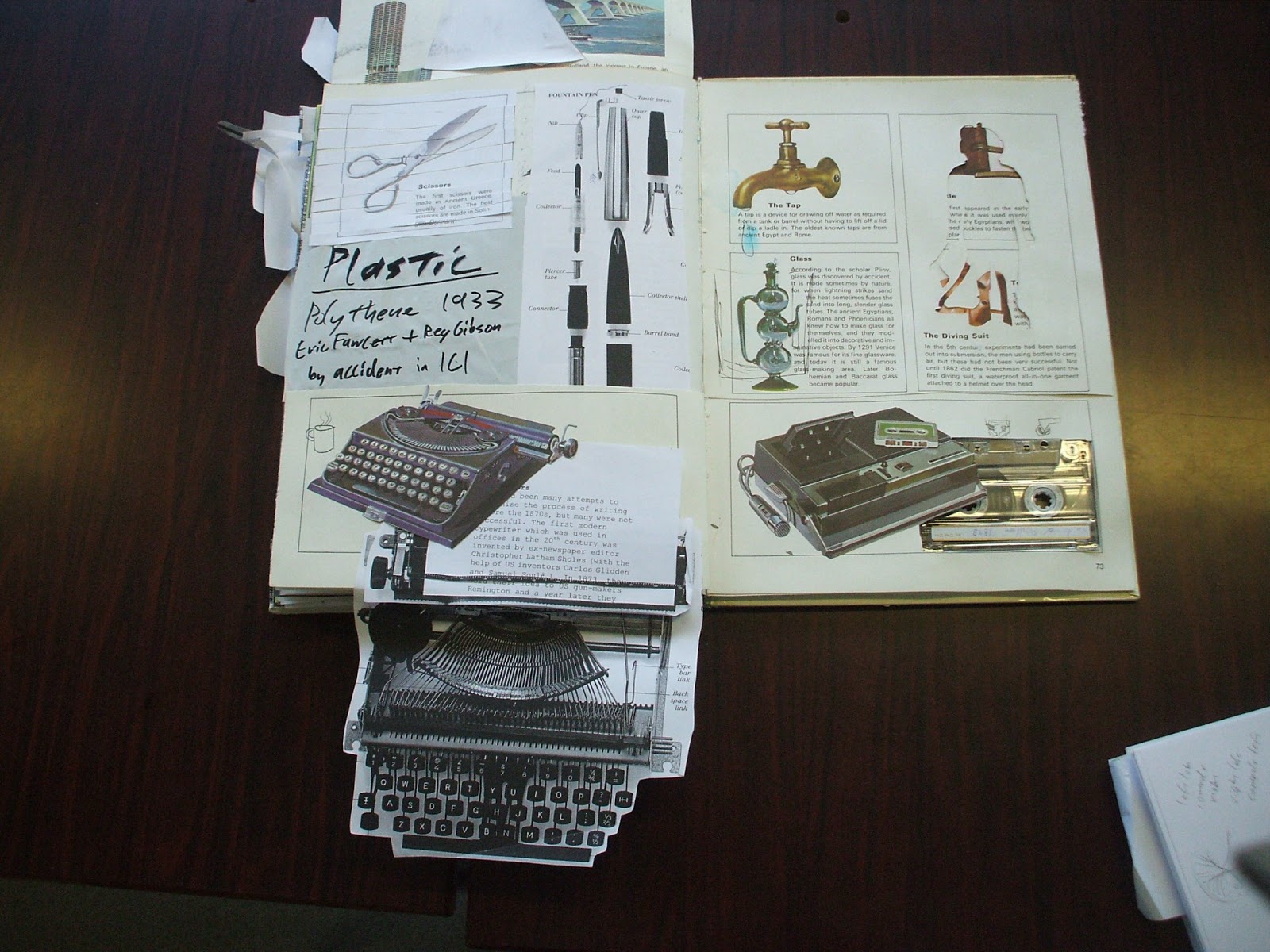
They had been many attempts to mechanise writing throughout the century before the 1870s but many were not successful. The first modern typewriter which was used in the offices of the 20th century was invented by ex-newspaper editor Christopher Sholes (with the help of US inventors Carlos Glidden and Samuel Soulé.). In 1873, they sold their idea to US gun makers Remington and a year later they produced their first typewriter. 


Written on the piece of plastic sheet (from one of countless bags I collected from Amazon.com) is

The scissors square is one reason why I made a digital copy of every page 
of this book before I "intervened" it. under the dismantled fountain pen is
a square covering the fountain pen.

A drip from the tap to the glass tumbler.
The diver is on the submarine pages 14 photos up.

Written on the cassette tape is "Valdemar Poulsen 1898,"
No adhesive was needed to stick the cassette in the book.


Closeup on font cover. A sort of joke and a nail to attach the project to the 1970s.