The first episode aired on TV Tokyo at
7pm on Tuesday 1st April 1997 and began with the start screen we get when the
games are loaded - a battle between a Gengar and a Nidorino. This then transitions "live
action" revealing the battle is taking place in a stadium. This battle is
televised and is on in a TV in a small bedroom. In that bedroom we are
introduced to the 10-year-old Satoshi (or Ash Ketchum in the English dub (I explained
how he got his name back in the introduction.)). We know he is very
into Pokémon (in the same way the real Satoshi was into insects) just by
the fact his room is filled with Pokémon-themed stuff. He is fully-dressed
(gloves and everything) like he is ready to go... but his mother interrupts his monologue and reminds
him to go to bed. As he sleeps he dreams about himself been the owner of
one of the three starters. But in doing so, he throws his poke ball-shaped
alarm clock and breaks it. When he finally woke up (to the sound of the cockerel) he discovers he is late and runs
to Professor Oak's Lab (in his PJs). When he
arrives his rival Gary had just acquired his starter and was
about to head off (in a car?).
In the original games your rival (whoever he's called) is a bit of a
jerk. He has the relation with the Professor and he somehow always a few steps
ahead of you. So its no surprise that in the anime Okido Shigeru
(or Gary Oak as he is called in English) is
depicted as a cocky, privileged bastard (which is also why "Gary
F*&%in Oak" has become an internet meme).
Throughout the first few years of the series Gary was the bane of Ash's
existence. Been the grandson of the great Professor Oak, Gary naturally
developed some form of superior complex, making him think he is somewhat better
than other kids his age, including Ash. And his famous relation is something he
liked to boast about....
"It's good to have a grandfather in the Pokemon business, isn't it." - Gary Oak (from episode 1)
A brief note - according to the anime novelization by the show's main writer
at the time Takeshi Shudō, Gary Oak in the anime is not only
Prof Oak's grandson but also the grandnephew of the mayor of Pallet Town. His cheerleaders are in fact electoral
staff. So the next time you'll see Gary in this first series (the cheerleaders
disappear during the Orange Islands arc) or see a "Gary
F*&%in Oak" meme online, picture Freddy
Quimby from The Simpsons (another cartoon
mayor's nephew). Here's a visual aid I made to help you....
Back to the story. When finally faced with the choice of three poke
balls he discovers that they were all taken (Why were the empty poke balls
still on the table?). Ash was gutted, but Oak then remembered that he has
one Pokémon left, but was reserved about giving it to a new trainer....
"Think I should
warn you.There is a problem with this last one." - Prof Oak
"I have to have
a Pokemon." - Ash
Well... in that
case...." - Prof Oak (from episode 1)
Oak gave in and opened the poke ball.... resulting in a flashy-lightning
show that revealed the franchise's mascot - Pikachu. Their first meeting wasn't
harmonious (he shook him with a thunder-shock attack). A shockingly
funny start to the series.
Here's a thought. What if that alarm clock didn't get broken? What if
Ash woke up early and was able to select his first choice (Squirtle (Which Gary took)) instead of been lumbered with
Pikachu? It's an interesting thought. It's a question that is worth exploring
in revisionist fan-fiction. But its a question that get's more integrating when
you discover who Sam is in the fourth
movie. (I'm not going to tell you. Find out for yourself.)
After leaving the lab Ash is given a send off, where his mother
proceeded to embarrass him in front of a crowd (as all mothers do in such occasions).
After Pikachu refused to enter his poke ball and shocking the crowd after Ash's
mother described their relationship as "weird" (and the reminder to
wear clean "you-know-what" everyday), Ash's journey finally
began.....
And its here we are confronted with a truth our rosy retrospection cognitive bias has made us forget from
childhood - on his first day as a trainer Ash was a complete moron! He was
dragging a reluctant Pikachu along with him with a washing line. He didn't know
that Pokemon only spoke the syllables of their names (an anime-unique invention
- in the games the Pokemon speak with typical animal noises, which you might
have expected before watching the anime). And (because Pikachu refused to
listen to him) Ash's first ever attempt to catch a Pokemon (a Pidgey) was a disaster. It's very shocking,
compared to the Ash we know and love and travelling in Kalos in 2016. It will
even shock Ash himself if we were to show him a video of his first day as a
trainer.
But you have to remember that much of this early idiocy is because of
Gary "motherf*&^in" Oak. For a long time before their
journeys began Gary poked fun at Ash's "inferior" position, leading
to Ash to develop an inferiority complex and a will to beat Gary at his own
game. Also this is his first ever day as a trainer. He probably had little
experience before this catching and training Pokemon, so cut him some slack.
But we have to ask a few questions. If Ash was such a fan for Pokemon, how come
he didn't know about the language thing? Surely in this world they are
documentaries about Pokemon on TV (with a few where Professor Oak plays David Attenborough). I guess he didn't watch such
documentaries. I guess (knowing his nature) he preferred watching the battles.
But that's no excuse. He would have seen them in the wild outside his home (and
heard them speak). But all this is just speculation - created by the lack of
continuity. In the end of the day, Ash (on his first day as a trainer) was a
young idiot thrown into the deep end.
And (in the end) one final act of stupidity will change his fate forever
- when a rock he threw hit the head of a Spearow. That Spearow got mad (of course) and
because of their "jealousy toward's trained Pokemon" Spearow began
to target Pikachu. After Pikachu gave Spearow a shock, Spearow called out for
his/her friends and a chase ensues. Pikachu was attacked. Ash fended them off
to rescue him. He ran with Pikachu in his arms and jumped into a river,
where He was fished out by a red-haired girl.
Her name (in Japanese) is Kasumi. Her name comes form
"kasumisō" the name the Japanese give to the Gypsophila genus
of flowering plant. It's also a pun of the words "kasumi" (meaning
"mist") and "umi" (meaning "sea"), which is how
we get her English name - Misty. The name makes sense if you know these two
things about her - she loves the water (which is why she specialises in
water-types) and can get very angry very easily.
And we first saw this trait in her reaction to the state of Pikachu and
Ash's ignorance at that moment (which included a slap
in Ash's face, which 4Kids edited out in the English dub). After
suggesting getting Pikachu to a hospital, Ash (upon seeing the Spearow
flock approaching them) "borrows" her bicycle and rode into
the distance. But (as a thunderstorm began) they hit a bump and fall over. As
the flock come closer Ash begs Pikachu to return to his poke ball. But he still
refuses (despite his condition). What happens next has become legend. Ash stood
up and faced the flock to protect Pikachu and proclaims...
"Spearows, do you know who I am? I am Ash from the town of Pallet.I am destined to be the world's number one Pokemon Master. I can't be defeated by the likes of you. I'm going to capture and defeat you all! You hear me! ...... Come and get me!!!" - Ash Ketchum (to the Spearow flock, episode 1)
Inspired by his words, Pikachu leaped up into a bolt of lightning and
gave the flock a massive thunder-shock to remember. When the storm
cleared Ash and Pikachu looked at each other with loving eyes, and one of the
most iconic partnerships in history was made. Above them was a rainbow and
a golden bird that the Pokedex had "no
data" on. A cosmic blessing from the universe, most likely.... or a sign
that Ash has entered a coma.
In the next episode Ash runs into Viridian City with the still injured
Pikachu. As he entered Officer Jenny was announcing to citizens
through Tannoy on be on the look out for Pokemon
thieves. She mistakes Ash for said thief, until he provided his ID... and showed how bad Pikachu is. With the
help of Jenny's motorbike (which might need some work done, looking at its
exhaust) Ash is handbrake-turned into the Pokémon Center in front of Nurse Joy at the reception....
"We have a
driveway you know." - Nurse Joy (episode 2)
Pikachu was rushed into critical care. While he was getting treatment
Ash was in the waiting room thinking about his situation. He called his mother
to say he was okay. Although they say a lot at this exchange, the words that
sum up this conversation is these....
"Honey, you are growing up right before my eyes, spreading your wings and soaring like a Spearow." - Delia Ketchum
"I feel more like a fallen Pidgey." - Ash Ketchum (episode 2)
A minute later Prof Oak called Ash to confirm the news that he got to
Viridian City so soon after beginning his journey ... and that he lost
$1million to Gary for betting that Ash would catch a Pokemon by the time he
reached there. Right after Oak hung up Ash was confronted by an angry Misty and
her (now destroyed by the thunder-shock) bike. But she cooled down soon after
hearing of Pikachu's condition.
But as Pikachu was moved from critical care to a place to rest an
announcement was made on the public Tannoy.....
"Your attention please. Our Viridian City radar sensors have detected an aircraft belong to a gang of Pokemon thieves. If you have a Pokemon in your procession, you exercise extreme caution." - Officer Jenny (episode 2)
That said aircraft was a hot air balloon, and it was hovering over the
Pokemon Center. The thieves dropped two poke balls into the center through a
skylight, revealing an Ekens and and Koffing. A smoke screen engulfs the reception and
the thieves finally introduce themselves with their motto .... which we have
all heard a billion times since. I know they jazzed it up a bit a couple of
times over the years with new words and graphics, but its still the same
motto.But hay. It has become a habit that they have trouble breaking, after
doing it every week for the past 20 years. All they need is for someone to say
the trigger words "prepare" and "trouble."
Design-wise Jessie is a combination of an old girlfriend of Takeshi Shudōwhen he was at school
and Marjo from Time
Bokan, while James is a combination of Leonardo Medici Bundle from GoShogun(a
series Shudōhad written for previously) and Benten Kozō Kikunosuke from
the kabuki play Benten Kozō. There back stories are both
tragic and typical for villains. Jessie was the daughter of a high-ranking Team Rocket member, who disappeared when she was
about 5. Because of this most of her childhood was spent in a foster home that
was so financially poor that sometimes she had no choice but to eat snow. When she
was old enough she left home to study to be a nurse, before giving up because she
was no Chansey. James (on the other hand) was born
into a rich family, but had to run away when he discovered how Christian Grey she is. (Try to deny this
metaphor after watching this edition of PokeSins. I dare you.)
Both eventually meet as students
of Pokemon Tech (where they flunked) and
joined a bike gang, before (separately) joining Team Rocket. So with such devilish pedigree, you'll
imagine that these two are good at their job as Pokemon thieves ... and
you were right. They were terrorising Viridian City and had a cool
wanted poster ....
That was until that night when they encounter
Ash's Pikachu.
To begin with they didn't see him as anything
valuable.
"We're not interested in your electric rat." - Jessie (to Ash)
"We only seek rare and valuable Pokemon." - James (from
episode 2)
You heard them.
They didn't see Pikachu as a worthy prize back
then. So what changed their minds?
Well, we can assume that until that night they were undefeated crooks.
As the group try to defend the center's store of poke balls from
them (with embarrassing results), Ash takes Pikachu away from them
until the trio catch up with them at the reception. It was at this point a
dozen Pikachu (who were acting as the center's back-up generators) show up and
shock them - with Ash's Pikachu standing on top to proclaim his fine
health, asking Ash for "Pika Power." With the aid of the
dynamo on the ruins of Misty's bike, Pikachu got a power boost that increased
their hit power so much that Koffing began to release gas which ignited. The
building exploded. The trio were charred and frazzled floating away
dangling from their balloon as it glided across the moon.
"Great. A cat
losing to a mouse." - Jessie
"That Pikachu is
no ordinary Pikachu." - Meowth
"It's certainly
very rare. A perfect prize." - James
"Let's catch
it!" - Jessie
"Perhaps we
well." - Meowth (from episode 2)
And then their balloon develops a puncture and are "blasted
off" for the first time ever. And thus, the downfall of Team Rocket (and
the other crime syndicates) began. One imagines that Wile E. Coyote went through a similar moment
when he first saw the Road Runner. What would have happened to them if
they hadn't decided to hit the Viridian City Pokemon Center that night? Could
have they remained top agents, who didn't spend ever single penny on traps and
machines? Who knows.
For the next twoepisodes (in Viridian Forest) Ash catches his first wild
Pokemon (a Caterpie that later became a Butterfree) and Misty (after we find out
about her Entomophobia) witnesses a side to Ash that'll
become significant in the future - his selfless caring heart for his fellow
creatures. A side that'll later cause a lot of worry for his friends and loved
ones, looking at his record for risking his life.
By episode 5 Ash was in Pewter City to face his first ever gym leader. Called Takeshi in Japan (maybe
as a reference to chief show writer Takeshi Shudō), in English he is known as Brock - because he specialises in rock-types. Ash's first attempt to earn a gym
badge (as you may work out now) was a shambles. Brock's Onix proved too tough to beat for
Pikachu. When Onix was using bind on Pikachu, Ash (upon seeing his
extreme pain) couldn't bear it anymore and forfeited the match.
That night, feeling dejected, Ash meets a mysterious man named Flint, who decides to help him - by attaching
Pikachu to a small disused hydroelectric plant. The scheme was a surprising
success, when Pikachu overloaded the generator and lit the night sky with high
amounts of electric power. The next day Ash returns to the gym. Misty (been a
water-specialist) offered her Pokemon to use, but Ash refused the offer,
wanting the defeat Brock with his own team. The rematch began with Brock's Geodude knocking out Ash's Pidgeotto (which he caught in Viridian
Forest). Then Pikachu entered the ring. The charging session made sure that
Geodude was out, forcing Brock to call in Onix. Pikachu tries to shock Onix,
but it fails, damaging the gym instead. Onix binds Pikachu, but this time
Pikachu gave off a massive Thunderbolt attack, hurting Onix ... but it
wasn't enough to win. Pikachu was a bout to pass out. Brock offers to end the
match for his sake. Ash refuses. Then the sprinkler system was triggered (from
the previous attack) seriously hurting Onix (rock-types don't like
water).
And it is here we see for the first time a significant trait in Ash -
his sense of fairness. He recalls Pikachu. He had a lucky advantage with the
sprinklers, but he choose to stop the battle, because he wanted to earn his
badges by his own strength and strategy alone (much to Misty's disappointment).
That last bracket is a surprise, considering that a number of
badges Ash "earned" wasn't earned due to a battle with a gym leader.
A fact Misty would made light of in the early parts of the series. A
fact especially true when it came to Ash's second gym (two
episodes later) - the Cerulean City Gym, where we are confronted
by Misty's "sensational" sisters. Long
story short, the sisters were just giving away badges and were about to give
Ash one, until Misty entered the scene and challenged him for it (as she
was technically a gym leader of that gym). The battle
was interrupted by Team Rocket. Ash saved the day and was given
the badge as a thank you by Misty's sisters (to Misty's dismay!!!).
Back to Brock. Just as Ash was about the leave Pewter City, Brock ran to
him to give him the badge anyway - for his kindness towards Pokemon he showed
moments ago. Ash initially refuses it, but Brock's reason to do
so convinced him to take it. Afterwards Brock confesses his ambition to become
a Pokemon breeder - but
family commitments prevent him from leaving the gym. He gave him the
badge so that Ash can fulfil his dream. But then a development -
Flint appears to reveal that he is in fact Brock's dad. He had left the family
a while ago to become a trainer. While he was away, Brock's
Mum left for the same reason some time later (but in
the original English dub it was said that she died looking after the
family (a typical anime trope), but this decision by the dubbers would come
to embarrass them when (years later) she
appeared on screen pretty much alive and well. But some
English-speaking fans think that the woman on screen is Flint's new girlfriend
or second wife (to try to rationalise the error.)). Things didn't
turn out well for Flint, so that is why he is back. Now that Brock no
longer needed to stay home (to look after his nine younger siblings), he decided to travel
with Ash. And the classic trio we all love came to been.
A life of a gym leader is tough. According to one source gym leaders work on a "three
strike" system. Loss three matches in a row and your loss your gym leader
status.So imagine the stress that could cause. So its no surprise that
(according that same source) the stress is the reason
Misty and her sisters are running the gym (their parents ran away
because of the stress) and the reason Brock's mother
is regularly "on the game." That last bit is cited as the
cause of one of Brock's most noted character traits - he falls in love with
every pretty girl he sees (especially every Officer Jenny and Nurse Joy).
Despite the serious reasons for this, this trait has given us multiple bits of
comedy, usually ending with him been dragged away by Misty (initially).
For the next 200-odd episodes Ash (whether he liked it or not) had the
experienced hands of two gym leaders following him (although one of them may
had ulterior motives for doing so (guess which one)). Without Misty and Brock's
guidance, Ash may not have become the trainer we know him today and (according to this review) "probably still in
the forest throwing rocks at random monsters."
Of course they are some out there who are going to point out that this
is a kids TV show cliché and it reeks of the often mocked meme "friendship is magic." However, I have found
a piece of evidence that proves that this isn't unique to kids TV shows and
fairy tales involving creatures not from this world. It can be found in the
world of high-brow "modern" literature....
"When one is trying to do something beyond his known powers it is useless to seek the approval of friends. Friends are at their best in moments of defeat." - from Sexus by Henry Miller
Henry Miller could have written about Ash when he typewritten this back
in the 1940s. Who would have thought that it was possible to reference Henry
Miller in a blog post about Pokémon.
The following post was written for an audience in the 15-above category.
Anyone younger or sensitive to stuff like swearing, blood and the other usual "offensive" stuff, or both who does read this....... don't say I didn't warn you.
"Nothing is more important than to see the sources of invention which are, in my opinion, more interesting than the inventions themselves." - Gottfried Leibniz
In the beginning there was nothing but chaos and nothingness.
Then, in the mist of all this, an egg came to be.
Then, hatched from that egg, was the creator of life, the universe, and everything -
Been the creator of a vast universe, Arceus created other god-like Pokémon to take control of certain aspects of the world, as it was very tiring been in charge of everything.
Arceus created Dialga to control time. Arceus created Palkiato control Space.
But, as antimatter (as any physicist knows) has the tendency to cancel out regular matter, Giratina developed a reputation of been destructive, and as a result was banished by Arceus to
With Giratina out of the way, Dialga and Palkia were able to create the universe
without that pesky antimatter ruining their work.
After their work was done, Dialga and Palkia retreated into their own dimensions....
That's, according to the people of the Pokémon universe, is how their world began.
However, been outside observers (like the Sphere in Flatland), we can see that this universe actually began with an observation of two kids playing with Game Boys connected together by a Link Cable and the imagined sight of insects crawling along it. But to understand how this image became the mega franchise that is Pokémon, you'll need to read about the life of the man who saw this sight and imagined those bugs.
Dr Bug
"Tajiri is an unimposing man, his face composed of sharp angles. His hands and lips tremble as he talks in a soft, shy voice. His eyes are bloodshot; dark circles ripple beneath them. He often works for 24 hrs. straight, then sleeps for 12. Tajiri is the kind of person the Japanese call otaku, those who shut themselves in with video games or comic books or some other kind of ultraspecialization, away from the rest of society." - Time magazine (November 1999)
Satoshi Tajiri was born on 28th August 1965 in Machida, a rural suburb of Tokyo that came to be in 1958. In other words, it was (what the British might call) a "New Town," like the place I went to school in - Cumbernauld. (I'm just guessing, based on what I can pick up from Wikipedia and his biography. I have never visited the place for real, so sorry anyone who actually lives or knows this place if I have painted an inaccurate picture.)
I imagine that the place is (like, Cumbernauld) a 1960s style Modernist town surrounded by woodland and farms. I know this with confidence because I went to school there (Cumbernauld, not Machida). During my time in primary school there one thing my class regularly did was to go out into the tree-covered areas near our school and explore them. Personally, I didn't like it. It was usually cold. I didn't like getting dirty. And (after been stun by a wasp at about age 7) I had a fear of them that made me uncomfortable hearing the buzz of insects (I admit, I am an unusual child. And for those thinking now of harassing me with wasp buzzes through speakers, it won't work. My ears can tell the differencebetween recordings and the real thing.). That last bit was more a factor when one one of these trips we were given containers designed to contain insects for examination (like the ones pictured here). Although some of things we collected and examined were fine and worth looking at (one caught a ladybird) one classmate caught someone I found alarming - a bee (I know there not as dangerous as wasps, but try explaining that to a child who just got stun by a wasp. I made my peace with them years ago, especially now that their numbers are declining). Because of these childhood experiences I can easily imagine a young Satoshi doing his favourite hobby as a child - been an entomologist (an insect collector).
"As a child, I wanted to be an entomologist. Insects fascinated me. Every new insect was a wonderful mystery. And as I searched for more, I would find more. If I put my hand in a river, I would get a crayfish. Put a stick underwater and make a hole, look for bubbles and there were more creatures." - Satoshi Tajiri (Time magazine interview, November 1999)
Like all children, Satoshi was fascinated by nature and all the creatures that live the forest, the fields, and the rivers that were found near his home. The following quote can also describe any curious (and brave) child's experience with nature. But in the later part we see how far Satoshi's obsession with nature then really went... and how clever he was compared to others kids at the time.
"They fascinated me. For one thing, they kind of moved funny. They were odd. Every time I found a new insect, it was mysterious to me. And the more I searched for insects, the more I found. If I put my hand in the river, I would get a crayfish. If there was a stick over a hole, it would create an air bubble and I'd find insects there. I usually took them home. As I gathered more and more, I'd learn about them, like how some would feed on one another. So I stopped bringing them home. But I liked coming up with new ideas. Like how to catch beetles. In Japan, a lot of kids like to go out and catch beetles by putting honey on a piece of tree bark. My idea was to put a stone under a tree, because they slept during the day and like sleeping under stones. So in the morning I'd go pick up the stone and find them. Tiny discoveries like that made me excited."
It has been well-known that Satoshi became so good at collecting insects and so knowledgeable on the subject that friends have nicknamed him "Dr Bug." This fact alone can all one to speculate that in an alternate world Satoshi Tajiri could have become a scientist in the field of entomology. At the time when Satoshi began catching bugs the whole activity of amateur nature exploration was transforming from a simple hobby kids (and adults) did (because they didn't have much distraction then) to a vital means of scientific data collecting bought on by concerns about decreasing biodiversity bought on by industrialization. It's a transition well-noted in the field of birdwatching. Insect collecting (like all things relating to insects) tends to be sidelined in such discussions about environmental science, which is a massive shame, considering the major role insects play in ecosystems (and how much biomass they take up and how massively diverse the taxonomic rank is). We are ignoring insects at our own pearl. What is happening to theBeedrill is may be only the tip of an iceberg. Could've the alternative Satoshi Tajiri (the world-renowned entomologist) change that situation? We will never know, because ,alas (as I suspect all of you have suspected by reading this), that didn't happen. The town-planners of Tokyo had other ideas....
As Satoshi got older his childhood passion received a massive set-back in the form of bulldozers and concrete. Like many expanding towns and cities at the time through the 1970s, the very woods and wet lands he haunted were disappearing under the steel and concrete feet of "progress"stomping outwards from Tokyo.
"The place where I grew up was still rural back then. There were rice paddies, rivers, forests. It was full of nature. Then development started taking place, and as it grew, all the insects were driven away. ... Every year they would cut down trees and the population of insects would decrease. The change was so dramatic. A fishing pond would become an arcade center." - Satoshi Tajiri (Time magazine interview, November 1999)
And that last thing ties in brilliantly with what happened next. With no places to find beetles, Satoshi's career in entomology came to a disheartening end. Fortunately, as he became a teenager, something else filled in that void - quite literally, in fact. One of the things that replaced the very fields he explored as a child was something very new to the world. Something that was still pretty much an infant compared to other examples concrete progress, such as highways, supermarkets, and Narita Airport. They had existed in some form before, but in the 1970s they had a massive transformation thanks to the Americans. Of course, I'm taking about video game arcades.
The Game Freak
"I'm part of the first generation who grew up with manga and anime, you know, after 'Godzilla.' I was absorbed with Ultraman on TV and in manga. The profession of game designer was created really recently. If it didn't exist, I'd probably be making anime." - Satoshi Tajiri (Time magazine, 22nd November 1999)
Satoshi Tajiri was from the first generation of kids who played video games. Tokyo's amusement arcades began to be filled with electronic cabinets from 1973, beginning withPong clones produced by Taito and Sega. Two years later Japan made their first ever games console - the Epoch Electrotennis. So by the time little Satoshi became old enough to become a trainer there was quite a choice of electronic amusement for him to distract him from the loss of that prime insect hunting field. Like many kids exposed to these games for the first time ever he was hooked - BIG TIME. Although many kids back then were hooked on arcade games, a number of them became so addicted they skipped school to play, causing the medium's first conflict against PTAs. "It was as sinful as shoplifting," He said to Time in 1999 "My parents cried that I had become a delinquent." But Satoshi's obsession with games went further than that. He really got into the THE GAME of his time - Space Invaders, a game that was so popular that it is rumoured to have caused an actual financial crisis in Japan - a shortage in ¥100 coins. Although the ¥100 coin shortage isn't actually true, what is true that Satoshi's "addiction" to Space Invaders was so huge that an arcade owner gave him a Space Invaders machine to take home. Now that is an interesting fact about his past. He was given an arcade machine by a generous arcade owner in his mid-teens. Think about it. A full-size arcade machine from this time is as big as a one-door wardrobe and probably as heavy as a cooker. How could a mid-teen in about 1980 be able to take an arcade machine home with him? Answer me that people. And how did his parents react to his new obsession (let alone the Space Invaders machine)? Well, judging from this quote, we can say with confidence that they reacted like almost all parents did in the early-1980s..... worried that he's wasting his future.
"As a high school student, Satoshi Tajiri liked to skip classes and play video games at a neighborhood arcade. One day his father got a call from a teacher: young Satoshi didn't have enough credits to graduate. With college a lost cause, Tajiri's father contacted a friend at the Tokyo Power Co. to help find his son a job as a lineman. I thought he could at least make a living that way, says the elder Tajiri. Instead, the boy turned his after-school diversion into a career: he took enough make-up courses to graduate and went on to invent Pokémon, the video-game sensation that is sweeping the world." - Don Morrison "To Our Readers" (Time magazine, 22nd November 1999)
Like a number of teens at the time, Satoshi did skip classes to play in the arcade. Given the choice any teen would.... especially in Japan. Do you know how though the Japanese education system really is? I have read a lot of "slice of life" manga that involve characters who are in high school, so I have a quite accurate picture of high school student life in Japan. And here's two facts that paint a shocking picture (for fellow teens, not actual adults who want eduction reforms). In the 1990s Japanese students spent two months more in school than their American counterparts. And (until 2002) they were mandatory classes been held by schools on Saturdays (since 2002 they became optional). I don't think I need to say more why teens like Satoshi would have preferred staring at a screen instead of a blackboard. But education is very highly valued in Japan.... seriously. It was a big pillar in the country's recovery after World War II, so a lot was invested in it ... leading to a kind of low tolerance towards underachievers and "slackers." Its no surprise that Japan ranks in the top 20 best educated countries by the UN. I know many will see this as true in many other places as well as Japan, but Japan's (and other Asian countries) serious attitude towards educating its people is at frightening levels.
So you now get why Satoshi's parents were worried about his new hobby.... and became more so when his grades began to suffer... to the point that it threatened his chances of graduating high school. This (of course) led to his dad (a Nissan car salesman) to try to get him a job at the Tokyo Electric Power Company. Now here's where something interesting happens. I assume that to the average teen facing such a situation back then, he would have taken the job. But Satoshi was no "slacker." He declined the job offer, took up make-up classes and eventually gained his high school diploma. And here's the best bit. After High School he attended a two-year technical degree program at the Tokyo National College of Technology, where he choose to major in electronics and computer science.
Are you getting what I'm picking up? Yes, Satoshi was taking his obsession with video games to (in the long run) a beneficial turn - instead of just playing them he began to think about making them. This was the early-1980s, remember. They were no college courses dedicated to making video games (probably, let). Very few then thought that the then-young industry would become the multi-billion dollar enterprise it'll become in the 1990s. If you wanted to learn how to make them you pretty much had to find a book or someone to teach you general computer programming (they were a lot of them about in the early-1980s) and work it out for yourself. And in a time when home computers and game consoles were a booming business, they were many who were willing to make their own software for their machines - and were not afraid to use a screwdriver, if necessary. Satoshi himself once took apart a Famicom to see how it worked and learnt how to program Family BASIC on it. He even went as far as to add external circuit boards to it to expand its capabilities. But before he took that screwdriver his desire to make games was already showing. In 1981 (aged 16) he entered (and won) a game design contest sponsored by Sega (a fact that shocks many today, considering that most of Satoshi's work is with rival Nintendo).
But this contest win led to nothing (to the relief of Nintendo fans).
In 1982 he channelled his obsession into something that became very successful and led to many jigsaw pieces coming together - a video game fanzine. Although the video game industry had industry publications in the 1970s, consumers only got dedicated articles or pages in already established publications. It wasn't until the early-1980s that magazines entirely dedicated to games first appear. In Japan their first one, LOGiN, was published in 1982. Despite this, until many years later, there was almost no official video game press in Japan. But many Japanese gamers and game developers were impatient, and decided to go DIY and made their own publications. Somewhat not surprisingly, many game developers wrote articles for these and official publications at this time. Yuji Horii (of Dragon Quest fame), for example, wrote a column in the obscure publication known as Weekly Shōnen Jump. Games were simple things then. Developers had more time to spare to freelance to write about their's and others work. Unlike today.
Satoshi's motive to make a magazine was his aspiration to make a better connection between players and developers. This was inspired by when game companies he wrote letters to replied back. When Satoshi was stapling together the first pages of the first issue of his the industry was at a size that game makers were beginning to become more corporate. Before, making video games was a cottage industry, where even a kid with a Sinclair ZX Spectrum in his bedroom could make and publish a best-seller. But, as anyone who knows the history of video games very well, a crash came in the US in 1983. Japan was spared this, fortunately for Game Freak. But the UK wasn't so lucky. As the ultimate example showing the transition that was going on, one victim of this crash was game developer Imagine Software. During it's short life, the company became hugely rich very quickly with a number of very successful games, becoming a poster boy for how much one can make making video games. Bruce Everiss, operations director of Imagine, said this about the company and the state of the industry at this time...
"We were inventing the industry as we went along. Up until Imagine, the industry had been a kitchen-table industry. Imagine was the first UK company to have things like a sales team, marketing people. we were the first to do multi-lingual packaging. We put programmers into offices, which was a new thing, and then started using sound and graphics artists." - Bruce Everiss (taken from p135 of Replay: The History of Video Games, Tristan Donovan (Yellow Ant, 2010)
But by 1984 overindulgence (they had plush offices that had a garage full of sports cars and once tried to rent out the disused revolving restaurant on top of St. John's Beacon in their home city of Liverpool), overconfidence, and large lashings of piracy ruined their finances. Many companies followed (but Imagine had it worse, because their downfall was immortalized on film by a BBC documentary crew). It was in this chaos that the industry began to "grow up." Managers and middlemen begin to invade the industry in this point, as a way to prevent any "cocky" decisions that would have led to disastrous ruin. And this will have affected how close players got to the developers. Before, the developer will have had the time to go to the arcades and check out what the kids were playing. A typical manager would have seen this as frivolous, but what they didn't realise is that what they were doing was actually (in fact) market research. But a form of market research that guaranteed great data. Instead of getting it from a bunch of kids placed in a white empty room (as most focus group sessions tend to take place) their getting their data from the very ecosystem their making for. As any anthropologist knows, you'll get the best data from the front-line (within the mist of it), and not by taking the subject out of its environment and prodding it in an alien one. In an unfamiliar environment (like the blank focus group room) the subject tends to find the setting uncomfortable (and more so because they know they been observed) and (as a result) ends up in a state where their quite reluctant to talk or answer questions with great (useful) data. This is the fundamental common-sense reason why most products whose creation was guided by focus groups tend to be.... terrible.
The industry was beginning to make crap games (one of the reasons for the 1983 crash) and (as it "grew up") the developers got isolated more from the players, leading to the creation of more games that the players didn't want. And it was in the middle of this that Satoshi's fanzine entered the ring.
The magazine Satoshi (and a few friends) made was called Game Freak(a pen name Satoshi used when he wrote freelance to other publications, such as Family Computer Magazine and Famicom Tsūshin). Issue 1 (according to this source) was published in March 1983. The magazine covered the then emerging arcade scene, focusing on arcade games in the form of strategy guides, reviews, and other general purpose articles... just like similar magazines in America and Europe. Originally a handwritten affair, this intermittent publication later became so successful that Satoshi was able to have it professionally printed. It ran until September 1987 and during that time the zine caught the attention of additional contributors,some of which will play a big part in the creation of Pokémon, with most significant been aspiring manga artist Ken Sugimori. He'll later become the designer of first 151 species and have final say on all future creature designs (and more). He saw the magazine in a shop and decided to get involved. His artwork can be found in many editions of Game Freak.
As the years went by (and the number of sucky games reached epidemic proportions) Tajiri and Sugimori felt that something needed to be done. Been the makers of a fanzine, I doubt that an editorial pleaing developers to make better games would've made much difference. So how could they dam the spread of crap games? Well, Satoshi and Ken made a massive decision....
On 26th April 1989 (sometime after publishing their last fanzine) Game Freak became a game developer itself.
So how did a fanzine become a game developer? In the case of Game Freak it was easy...
"When we first started, some of the readers were actually programmers and they had the skills and access to the hardware - that's how we started in producing video games." - Ken Sugimori, GamesTM quote, taken from Retro Gamer Issue 135 p23 (November 2014)
With a readership full of trained-programmers and designers, finding skilful people to help make the transition was a simple as advertising in their zine and saying to former collaborators "Would you like to make games with me?"The only difficult bit was obtaining the equipment needed to put games onto Famicom cartridges. (It was this reason why Nintendo stuck with cartridges for years - their hard to copy without specialist equipment).
Soon after its founding, Game Freak quickly pitched its first ever game idea to Namco - an arcade-style puzzle game where your aim was to save a girlfriend/princess for the NES. This game was Quinty (a game known in the US as Mendel Palace). Satoshi now had a foot in the gaming world.
It was during the development of Quinty Game freak gained everyone that would eventually make Pokémon a reality. One of them was programmer and music composer (and trombone player) Junichi Masuda. He had a corporate office job until he was approached by Satoshi with the idea of making the music for Quinty. It must have been a stifling job, as he quitted it soon after. And the world is richer culturally thanks to that. His biggest contribution (of course) is the soundtrack. If you were to describe his musical style into three words it would be classic meets techno. He discovered classical music in high school and has used it as his biggest influence, especially the works of Stravinsky and Shostakovich. And you all thought video games were only soundtracked by rock and techno alone. However, he had said that techno is his favourite musical genre. But this isn't a surprise, considering the technological limitations he (and others) had to deal with when making music for video games at this time. By 1990 the audio technology of games had barely evolved from the beeps in Pong. This is mostly because of the limits in data storage in cartridges and the processing power of most game devices (16-bit processors were only beginning to be used in consoles in the late-1980s). High quality live musician music won't come to games until the wide adoption of CD-ROM drives in the 1990s - for home consoles and PCs anyway. Handheld devices still had to make do with advance beeping until well into the 2000s (as anyone who used a mobile phone with a ringtone during that decade will tell you).
Despite the limitations, Masuda's fusion of 'The Rite of Spring' and 'The Robots' (not literally. I'm just listing examples from the genres here) created one of the noted pieces of the soundtrack of the 90s childhood. Since then he has helped create the soundtrack of the all the games and (since Gen 2) directed, produced, and designed much of them as well, with his biggest contribution been the Hoenn region (based on Kyushu, where his family use to go on holiday). He'll be important in later years, as I'll explain in Part 2.
By 1990 everything that was needed to make one of the greatest video game franchises in history had fallen into place. All that was needed was (as the Americans call) the "flash of genius."
"I saw Game Boy when it was first released. The idea for Pokémon clicked in my mind. The basic idea for Pokémon seemed a good fit for Game Boy." - Satoshi Tajiri (Time magazine, 22nd November 1999)
According to folklore (by Satoshi himself), the idea of Pokémon began with the observation of two kids playing Game Boys connected with a link cable...
"I imagined an insect moving back and forth across the cable. That's what inspired me." - Satoshi Tajiri (Time magazine, 22nd November 1999)
That imagined sight of bugs crawling along the cable was bought on and inspired by his childhood memories as a bug collector.... Then he remembered when his hunting sites disappeared under steel and concrete... and how video games filled his void. This flashback made him realise something....
"Places to catch insects are rare because of urbanization. Kids play inside their homes now, and a lot had forgotten about catching insects. So had I. When I was making games, something clicked and I decided to make a game with that concept. Everything I did as a kid is kind of rolled into one--that's what Pokémon is. Playing video games, watching TV, Ultraman with his capsule monsters--they all became ingredients for the game." - Satoshi Tajiri (Time magazine, 22nd November 1999)
Pokémon was an attempt to reintroduce the trill of collecting objects from the natural world the young Satoshi had to urbanized kids who had little or no access to real nature to make it possible for them to do it for real. I think this is something many have forgotten or never realized about Pokémon. It may appear to be a fun RPG involving capturing and battling cute critters, but Pokémon is in fact the stealthiest product form the environmental movement ever created. Without realizing it players (who are mostly around 10) were taught valuable lessons about life, nature and the environment through the best means of teaching a kid could have ... by example.
"Nature teaches more than she preaches. There are no sermons in stones. It is easier to get a spark out of a stone than a moral." - John Burroughs
You can talk from a pulpit saying to (possibly) millions of people at once about anything, like the plight of the polar bears and why fossil fuel use is causing their homelands to melt. But people aren't really going to "get it" until it actually affects them personally, like when their coastal home gets flooded by raising sea levels. This is more true with kids. Phobias (for example) are learned, and many people develop irrational phobias due to a bad childhood experience - such as Misty'sEntomophobia and Gyaraphobia. This can be summed up with a saying: A kid isn't going to learn not to touch the stove until they actually touch the stove... or (at least) see a film showing a similar child doing just that and the consequences very graphically.
So what lessons is Pokémon teaching. you ask? Well, let's breakdown the premise of Pokémon. You play a ten-year-old who decided to become a "trainer" - your job in the game is to train animals (a job that is very hard in the real world ... and can involve certification (which, I imagine also happens in the Pokémon world - not everyone can be a trainer). But to do so you have to find them first, and that involves exploring the world you happen to be in. You are encouraged to rummage through the trees and tall grass outside Pallet Town to find and capture your first wild Pokémon. With that first catch that creature appears in your Pokédex and you'll find out some interesting things about it, like the fact Pidgey "flaps its wings at ground level to kick up blinding sand." After that first catch, the thrill of the battle makes you want to do it again (and that Pokédex entry stirs your curiosity). The game has made you want to know more about this world. You had been told that they are 150 species of Pokémon in this world. What do you do? You go out there and find them of course. And in doing so you'll learn a lot about these creatures - their various forms, average statistics, abilities, and the odd pub quiz fact about them, like the fact Vulpix is born with one tail that become six as it gets older. Don't you see what is happening? The game has turned you into Dr Bug - a kid who is fully aware of the wide variety that exists in nature - you have been taught about biodiversity.
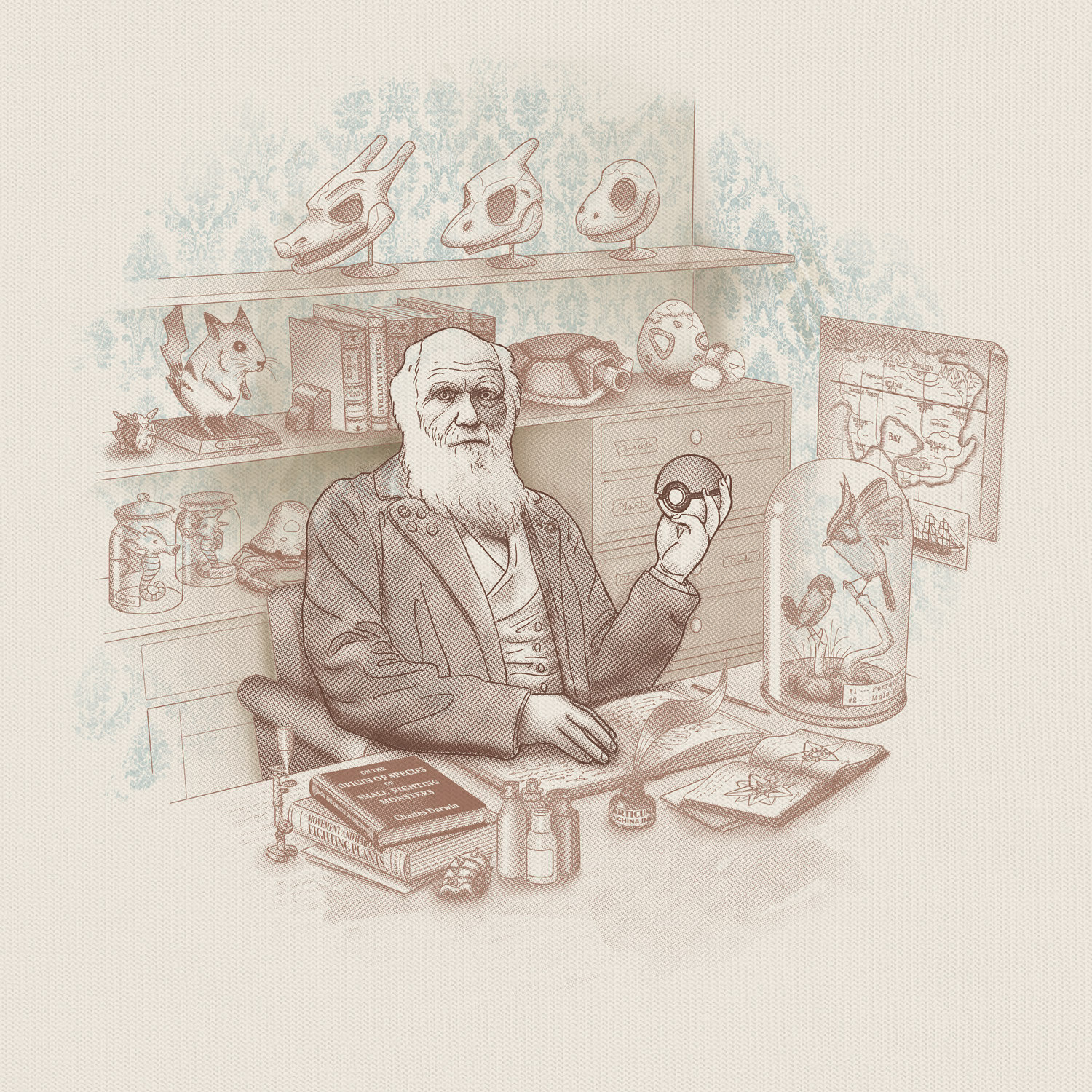
As you go on exploring the world you are regularly challenged by other trainers to do battle. During these battles you are exposed to two things - the brutality of interspecies conflict and the need to adapt to win. These are two things that are the driving force of evolution (the Pokémon version of it and the real world version, as described by Darwin). Now, it must be pointed out here that in the games (and the anime) the most extreme outcome to a Pokémon that lost a battle is that it faints of exhaustion. No creature actually dies in battle (in the games). This is a massive point about the games that (I think) has to be voiced more often by fans and gamers in general...
because it was a concious decision by Satoshi from the very beginning....
"I was really careful in making monsters faint rather than die. I think that young people playing games have an abnormal concept about dying. They start to lose and say, "I'm dying." It's not right for kids to think about a concept of death that way. They need to treat death with more respect." - Satoshi Tajiri (Time magazine, 22nd November 1999)
So don't worry concerned guardians, Pokémon is not as brutal as you might think. At least no young Deerling'smother gets shot with lead, which brings us to the next lesson....
While exploring and challenging trainers and gym leaders you encounter a criminal organization (Team Rocket in the first games) that exploits these creatures, like disposable tools or saleable commodities. In the case of Team Rocket in Red and Green they give out captured creatures as prizes in a innocent-looking arcade (like Magikarpin bags), excavate and sell fossils, and commit invasions of private property and the odd act of murder. Later on in Johto, they hold the Slowpoke in Slowpoke Well hostage to prolong a drought and cut off some of their tails to be sold as a delicacy. To hammer in their evilness further the creators in all its mediums use the ultimate meme of evil in this "modern" era - they have been depicted a number of times in a similar way to the Nazis....
Still from fantasy sequence from the original Japanese version of episode
(It was heavily airbrushed in the English dub for VERY obvious reasons.)
This infamous still also highlights another meme - the use of colour. Have you noticed that Jessie and James in the anime mostly wear white compared to other Rocket agents (like Butch and Cassidy)? Most agents wear the stereotypical black uniform, as a cultural cue that they are bad. But Jessie and James stand out by wearing the negative version of the uniform. Why? The answer is simple. Their track record is (let's be honest) terrible (compared to Butch Cassidy and others). Everyone knows that. But how many of you know that during times the times they had high levels of success (during their training daze and their early times in Unova (which I'll explain later)) they wore dark-coloured uniforms (they wore dark red clothes during their training daze - blood red). I'm not lying. Here's visual proof.
Jessie, James and Meowth during their "training daze"
The trio during early Unova episodes
You see, the hue of their clothes indicates their level of badness. It's similar to the use of black and white hats in early westerns and (maybe) that is why the not so good droid searchers that we call storm-troopers are white compared to the commanding officers of the Empire.
In general, kids are taught straight away that Team Rocket are bad people. Their oath says it all...
"Steal Pokémon for profit. Exploit Pokémon for profit.
All Pokémon exist for the glory of Team Rocket." - Team Rocket oath
And that last part says something that is common to all the villains in the Pokémon universe, from Rocket to Flare (via Galactic). All their goals involve controlling the natural world in some way.
Remember my conclusion about the Pokémon world been a nature-friendly future? These gangs are used to embody all that is maleficent in our world that prevents this future from becoming true - beliefs that humans are one over nature, the personal desire to control it to their will like a thermostat, and (most importantly of all) the idea that it is there alone to be exploited for our gain. The fact that Jessie and James usually fail their missions is a sign of the very aims of their organization(s) are (in the real world) exercises in futility.
Please note that all this is all speculation by this bloger and should not be seen as 100% fact.
And this brings up another thing about Pokémon. Been based on nature itself, Pokémon has a huge advantage when to comes to capturing children's imaginations than other monster-collecting franchises. Kids can relate to it easier, especially if they are in the garden, park, farm, forest or other place where nature in some form is allowed to exist. Think about it. Can you imagine a child who is into Pokémon playing near a pond and noticing the tadpoles in the water and then saying "Poliwag!" Then that child sees a turtle nearby and then saying "Squirtle!" Then that child seeing a sparrow on a tree branch and saying "Pidgey!" You can, can you? Exactly. Digimon can't do that. Moshi Monsters can't do that. Not even Yo-Kai Watch(a recent creation that has already been dubbed by some as "Pokemon Part 2" due to its huge popularity when it was released in Japan in 2013.) can't do that (but the use of yokai is a great idea, though. Watch out for it people.).
(Please stop using the inaccurate (and damaging) cock-fighting metaphor to describe Pokémon battles. I explained why back in the Introduction.)
And this use of nature as a template goes further. By using real animals as inspiration Ken has to consider the environment these creatures inhabit in their final designs. That is because in nature an animal (if it wants to survive) has to adapt to work successfully within the parameters of their environment. This drive to adapt to suit their environment is a driving force in (real world scientifically-defined) evolution. Any character designer with some knowledge of biology would have noticed that when they admire Ken Sugimori's designs. For example, the whole of the new batch of creatures created for Gen 3 was highly noted for their design difference from the previous generations. It was a deliberate design decision, because of Hoenn's more tropical climate compared to the more temperate climate of Kanto and Johto and the fact Hoenn is an island. Even species that seem like the products of lazy imagination (like Magnemite or Grimer) make sense, if you consider the environments where they can be found (such as power stations or polluted waterways).
In fact, you can use Pokémon to easily teach the idea of evolution (as defined by science). A great example is this video from the The Game Theorists YouTube channel....
Game Theory: How Pidgey "Proves" Darwinian Evolution
This direct connection between Pokémon and the science of evolution hasn't gone unnoticed by the fandom. Charles Darwin can be found in a number of examples of Pokémon fan art, such as this noted example posted in 2010...
Its no wonder creationists hate Pikachu (despite the fact that in the real world Pikachu's shocking abilities could be considered a good example in the argument of intelligent design).
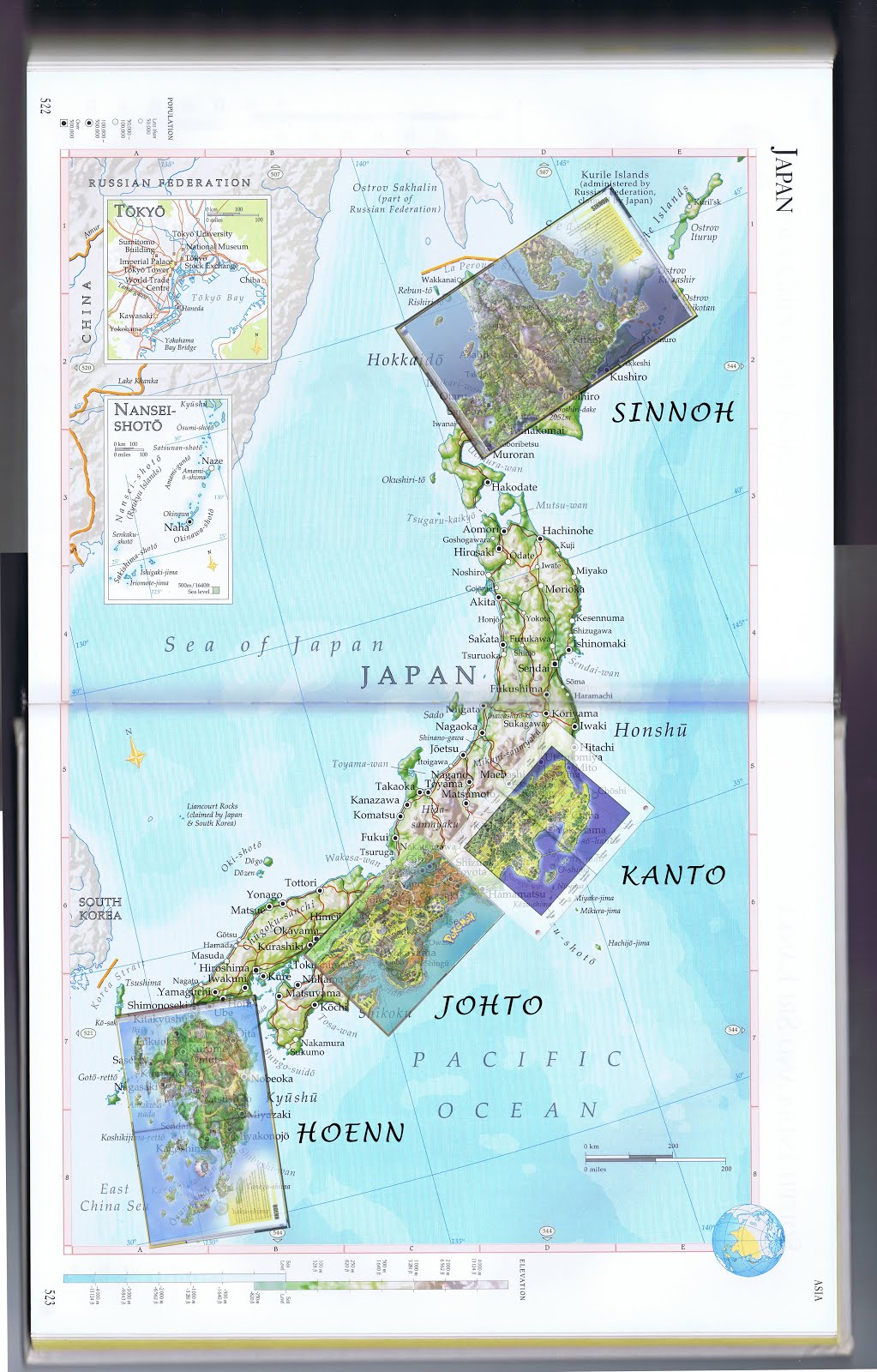
And here's another real world inspiration. Nearly every location in the Pokémon version of "Earth" (it isn't Earth officially, remember) is based on a real world location. I'm not kidding - it's true. You'll think that the creators created Kanto, Johto, Hoenn, Sinnoh, Unova and Kalos out of thin air? For example, Pallet Town (the home of Satoshi (Ash)) is based on Machida (the childhood home of Satoshi Tajiri). Cinnabar Island is based on the island of Izu Ōshima, which has an active volcano and is a big tourist spot for mainlanders. Mt. Silver in Johto is based on the iconic Mt. Fuji. And (more recently) Lumiose City is based on Paris. Even its gym (the Prism Tower) is sort of based on the Eiffel Tower. In fact, you can get the maps of Kanto, Johto, Hoenn, and Sinnoh and you can quite easily fit them onto a map of Japan, like what I did below...
So nature (through Satoshi's childhood bug-collecting hobby) is the main influence in Pokémon. But there is another noticeable influence that is worth noting. Without this influence Pokémon will have looked very differently to what we know. In fact it may have not have one of its main features - the Poké Ball. The aesthetics of the Pokémon universe owe their look to one of the most influential manga artists of the late-20th century - Akira Toriyama, the creator of Dragon Ball.
If you are familiar with Toriyama's aesthetic (and the capsules in Dragon Ball) I don't need to say more. But for those who are not, here's a few images that demonstrates Toriyama's influence (in the Anime, at least).
And the most-obvious influence of all - the capsule
And all that is just a taster. Toriyama's work was a massive influence on Ken, which shaped his character, prop and architectural designs for the games (and other media).
But Dr. Brief's capsules aren't the only capsules to inspire Satoshi and co. Another source was the Gashapon machines (those small vending machines that dispense Kinder eggs without the chocolate). Not surprisingly, Pokémon toys have become the prizes in these machines when Pokémon became big. But back in the development stages, Game Freak considered calling the franchise "Capsule Monsters" because of this. But difficulties trademarking that name forced them to change the name to "CapuMon." Later on it was changed to "Pocket Monsters," which was then contracted to "Pockemon"(so it could fit on the GameBoy's small screen). Today the franchise is still technically called "Pocket Monsters." It only became known as "Pokémon" (with the accent) when the franchise entered America, where they had to change the name to "Pokémon" because of existence of the similar and non-related Monster in My Pocket franchise (which first came out in 1990).
A final influence was the RPG concept itself. The Pokémon games are (essentially) a typical Japanese RPG with a few modifications. In most other RPGs, you gather other members to form a party throughout the storyline. In Pokémon you (the trainer) create your team by encountering them (randomly) in the wild... or by buying them from theGame Corneror aMagikarp salesman. The only "party members" you get in the planned storyline in Pokémon are your starter (which you have a choice of three) and the final "boss" (Mewtwo in the case of Red and Green).
Another modification was the increased degree of in-world socialization. All RPGs feature some degree of in-world socialization, as some challenges require the help of others, such as that helpful old man who knows the password to that den. In Pokémon this it deliberately ramped up and forced upon you. This is the most integrating thing about the Pokémon games. They have the illusion of a open world, but the truth is (on your path to become a champion) you are forced to follow a certain path through programmed sprites. If you try to leave Pewter City without beating Brock a guy on the route out will walk up to you and pull you back to the gym, thinking you got lost. (This is something I remember encountering when I played Pokémon Red. I didn't go very far. Never bet Surge.)
But one thing that was really in you control was your ability to trade items with others. This is another staple in many RPGs, but Pokémon took it to the next level.... because of a problem Ken and Satoshi encountered while playing...
I have heard from one trusted source that one thing that led to the increased social aspect in Pokémon was something that happened while Satoshi and Ken were playing Dragon Quest III on their NES (another Toriyama influence). Ken had found more than one extremely rare hat in his copy of the game. Satoshi wanted one of those hats, but because their games were on different cartridges it couldn't be done (this was way before the internet changed RPGs). So when the Link Cable came along, Satoshi jumped at the chance to make a RPG with a huge social factor. By linking their GameBoys with the cable, different players can trade items (or Pokémon) with each other when their in a Pokémon Center (or some other place where trade is possible). So when a player manages to capture two rare creatures that player can easily exchange one of them to another player who wants one.
These ideas finally came together in the form of a design document entitled 'Capsule Monsters'. (Click the link and see the early artwork.) This document feature many ideas that'll become staples in the games and early sketches of a number of species (including Rhydon - the first Pokémon ever created.).
One interesting thing about this document is that it originally proposed that you didn't need to battle a wild creature to catch it.... if you were lucky. An early idea was that the player had a "charisma stat" that determined how willing wild Pokémon will team up with the player. The player had to raise it somehow to make a Pokémon join them. The player even (optionally) had to take part in the battles themselves in the same way as a lion tamer. (This early idea is evident with the presence of trainers with whips in the games). Fortunately, all this was later scrapped with the "weaken it to submission and throw a poke ball at it" idea we're all familiar with.... and thankfully we didn't need to get involved in the battles personally. In the early deigns the trainer can stay in hotels that have devices that allow their Pokémon to heal (while resting from that battle). This later became the Pokémon Centers we're familiar with.
All this was the idea Satoshi Tajiri pitched Nintendo in 1990.
Nintendo was initially reluctant. They couldn't grasp the concept of it. Here's a challenge. Try to explain the premise of Pokémon to someone who has never heard of Pokémon (I know they as rare as shinyDarkrai, but they do exist). If you somehow do find such a person, you'll discover how it must have felt to be Satoshi Tajiri when he first pitched his idea back in 1990.
But thankfully Satoshi had a ally in Nintendo - their chief game designer Shigeru Miyamoto ("The Spielberg of Video Games"(according to Time magazine in 1996)). The banjo player that bought you Mario, Donkey Kong, and The Legend of Zelda. For the first year or so of his career in developing games, Satoshi was under the wing of Miyamoto. In that "apprenticeship" (you could call it) Satoshi learnt a lot from Miyamoto. From him Satoshi learnt how to make games that'll engage with an audience and gained a significant ally when it came to pitching the idea of 'Capsule Monsters.'
In its final pitch Miyamoto added a significant suggestion that'll become a staple in the franchise - the game will come in the form of two near identical versions. But each version will have a different set of creatures in them. This meant that for a player to "catch-em all" they have no choice but to link their Game Boys with another player's Game Boy (containing the other version of the game) and trade for the ones that are missing in their Pokedex.
With the help of Shigeru, Satoshi's dream was finally green-lighted by Nintendo. And (as a big thank you gesture) Satoshi paid back the debt he owed to Shigeru with a tribute in the final games. In the first Pokémon games the default name of the main protagonist that you play is called Red, while his rival is defaultly called Green (or Blue in the English version, for reasons that I'll explain in Part 1). In the original Japanese versions the alternative name Red has (unless you choose to customize it to a name of your creation in the start menu) is Satoshi (after Mr Tajiri) and the alternative for Green is Shigeru. The idea of naming the rival that's somehow always a few steps ahead of you after Miyamoto-san makes a lot of sense, considering Satoshi's time under his wing.
(As an interesting fact, original artwork suggest that Game Freak did consider including a female main character. But development problems led to her been excluded in the final versions. This character later did eventually become real - in the form of Leaf in the Redand Green remakes (FireRed and LeafGreen). To add confusion, in the Pokémon Adventures manga (muchly based on the games storyline), she exists as a character named Blue (in the original Japanese) or Green (in the English translation). I'm sure you all can work it out for yourself.)
And that is how the Pokémon world actually came to be.
All that was needed was to do the coding and make the cartridges.
But before that I have one big question that I think needs addressing....
Is Satoshi Tajiri Autistic?
"Pokémon must have been invented by a team of Japanese engineers with Asperger." - Michelle Garcia Winner, Director of a clinic for autistic children in San Jose(quoted from 'The Geek Syndrome' by Steve Silberman, Wired, December 2001)
For years I have heard that the creator of Pokémon is autistic. I'm not talking about the low-functioning kind most people think of first when someone mentions "autism," I'm talking about him been on the high-functioning end of the spectrum that use to be classified as Asperger Syndrome (for those who are not aware, Asperger Syndrome was removed form the DSM in 2013. Autism Spectrum Disorder (ASD) is now used. I'm kind of an expert on the field.). It's something that has been speculated for years, since people first heard about the life of Tajiri (as proven by the above quote from 2001). With the creator of a franchise that has bought joy to millions been rumoured of been on the spectrum its no wonder that he is quoted in many pieces of autism-themed media, like a role model. The following quote from a blog in 2011 is typical....
"Once again, we discover that the world is a richer place because of the fascinating contributions made by individuals on the autism spectrum. The fact that Satoshi Tajiri, who was both socially and emotionally challenged by his disorder, could bring such joy to so many children is both heartwarming and inspiring." - Susan Moffitt, "Pokemon Creator Draws Creativity from Autism" (Autism Key blog, 28th February 2011)
But here's the thing. The first "confirmed" reference we have of this "fact" is in this book....
Here's the full quote from page 33 of this book....
"In spite of Pokémon's global fame and popularity, Tajiri remains a quiet, private person. Some have called him reclusive and eccentric. Many believe these characteristics are a result of Asperger syndrome (AS), a type of autism. While Tajiri confirmed this diagnosis, he has not discussed it publicly."
It then talks about what AS is. Despite the humbleness of this publication, this book alone is the only possible direct reference we have of Tajiri confirming his diagnosis. But is this source reliable? Well for one thing its main reference (or only reference) is a feature on Time magazine in 1999. With just one indirect source, can this publication be truly trusted as 100% fact? Is the "fact" of Tajiri's "confirmed" diagnosis just speculation? That is possible. Autism is characterized by behaviour traits that can be found in other neurological disorders, such as Schizophrenia (a common misdiagnosis many autistic children got in the mid-20th century).
So what is the truth, regarding Satoshi Tajiri's neurology? I can't give a call. He has the behaviour traits of low socializing and obsession with a narrow field (insects then video games), but I can't really say unless I actually meet him in person. There is a video clip of him been interviewed in 2007, and (to be honest) I can't tell. So (for those people who write text and arrange stuff involving autism) until he actually comes out and announces his neuron-status be careful when using him as a role model of neurodiversity - if you are the sort who cares about reporting accurate facts (like me).
But should we really make a huge song and dance about it? Should we even bother asking the question "Is Satoshi Tajiri Autistic?" From the comments of the video I just referenced I found this inspiring comment (a vary rare thing on the internet)...
"I don't know if satoshi has Asperger's or not and the truth it's really dosn't of our business and it dosn't matter but you forget one thing people that person created the product that we are so love Pokemon, but I know one fact this person is very clever and creative this is what important i think" - Tal Cohen (YouTube comment, November 2015)
Quite right. Let's end this tangent now and never speak of it again.
The Problems of Building a World from Scratch
"[Satoshi] had an idea of trading monsters. When I heard about that idea, I thought it was an interesting, fantastic idea. However, you then have to realize it, and make it into a game. The concept itself was very interesting, so you could expand and see how you could develop it into one game." - Junichi Masuda (from this 2009 interview)
The games that we know as Pokémon Red and Greentook six years to complete - the longest development time any Pokémon games have ever had. It had to be, because it was the first. And those six years were though for Game Freak. Nine people were given the task of making them, which may sound enough to outsiders. But those outsiders don't realise how much time and effort is needed to design and make a large world game. To compare this to another complicated product made possible by computers made in about the same time, 27 people were employed by Pixar to animate Toy Story.
I admit that Toy Story is a 3D animated feature film with "realistic" texture rendering (by the standards of 1995), but Pokémon Red and Green were interactive adventure games populated by possible thousands of people and creatures. And before any of you bring up the fact that the games' characters were only in the form of simple sprites and that Woody alone had 723 motion controls, with 212 for them used to control his face and 58 of them were for his mouth, it has to be pointed out that Pixar had some of the most advanced computer technology available. Game Freak had a more basic set-up, due to the fact that the GameBoy was (in fact) an 8-bit processor console with 8kB of RAM and a 2-bit colour palette. (Basically an Atari 800 with a faster processor in a small package).
But all those six years were not all spent coding on computers that could potentially self-destruct. A lot of time in the early-1990s was spent fleshing out the game's story - the quest to be a master, the gym battle system, the Elite Four, Team Rocket and the creation story of Mewtwo .... and the design of all the characters, creatures and the infrastructure. All of that takes time, and Ken can only draw so fast. It's like Pokémon was going to become the thing that'll define them... and (after 20 years of sequels) it kind of has....
"To most gamers, Game Freak is the House of the Electric Mouse,...." -
Now, before I continue it is worth pointing out that Game Freak isn't just "the House of the Electric Mouse." Game Freak has made other games too during (and after) the development of Red and Green. In fact in 1994 Game Freak released their second most-iconic game - Pulseman. You may have not heard of this game because...
And Pokémon was not Game Freak's first game for Nintendo, neither. That first belongs to Yoshi(The green dinosaur from the Mario universe). According to their Wikipedia page Game Freak developed eight games during those six years. These include Smart Ball, Mario & Wario, and a game tie-in with the manga series Magical Taluluto (whose main character kind of reminds me of a Munchlax). And remember Game Freak was a small company back then...
"At that point, the different people who worked on the Pokémon games were nine people. There were other projects going on, and there were 20 people in all. Now [in 2009], it's more than 60 people working on various projects." - Junichi Masuda (from this 2009 interview)
Game Freak nearly went bankrupt creating Pokémon (Escalating costs of replacing broken computers?).They were barely able to pay its staff. When staff were told about the financial situation five employees quit. (One wonders what happened to those five?) Even Tajiri himself gave up his salary to help relieve the situation. Instead of a salary he was supported by his father. (One wonders what daddy would have thought about this and what have happened to him up to then. When Satoshi took that two-year course on electronics, Mr Tajiri must have thought Satoshi would become a electrical repairman... and not a big figure in an industry in its adolescence.)
So, with financial trouble, multiple games in development, busted computers, and a small staff (which became smaller when the money dried up), one wonders how Pokémon managed to get made.
Eventually Game Freak received a cash-injection from a third party - the rather fittingly-named Creatures Inc. Founded in March 1989 (as Ape Inc) by the multi-talented Shigesato Itoi, its creation was a suggestion by Nintendo's then president Hiroshi Yamauchi, who liked Itoi's work. The developer was responsible for the successful Motherseries for Nintendo. It became Creatures Inc after it faltered during the making of Mother 2 (known to Westerners as Earthbound). They had to call in help from outside - Satoru Iwata from HAL Laboratories. After Earthbound was completed Ape Inc disbanded and reformed (on 8th November 1995) as Creatures Inc, with a new boss - former Ape Inc game producer Tsunekazu Ishihara (later president of The Pokemon Company). In return of financing Game Freak, Creatures Inc gained one-third of the franchise rights to Pokémon, giving staff there some feet into the franchise and the right to add bits to it. (Its current president Hirokazu "Hip/Chip" Tanaka (for example) is a music composer and wrote songs for the Pokémon anime. He was later forbidden to do so by Nintendo due to their company policy of not allowing employees to work for other companies. He later resigned from Nintendo because of this conflict in 1999 to become a full-time Creatures Inc employee, where he later became its president in 2001.)
Despite the set backs, by 1995 the games must be in a state that Satoshi found satisfactory. In that year he wrote this book - Satoshi Tajiri: New Game Design. It was a general state of the industry book for gamers, which included a sneak preview of the Red and Green.
By the end of that year the games were complete. After those six long years, you'll imagine that Satoshi would be relieved to have finished his games, right....?
"When I finished Pokémon, I thought Nintendo would reject it. I was like a baseball player sliding into second base knowing he's going to be out. But somehow, I was safe." - Satoshi Tajiri (Time magazine interview, November 1999)
Why would Satoshi Tajiri say that?
What happened to have made the very people who made it doubt their success?
Find out in Part 1
FINAL NOTE: I have noticed that many online sources have made the mistake of confusing pictures of Tsunekazu Ishihara (president and CEO of The Pokémon Company) with that of Satoshi Tajiri. In fact its so widespread that if you did a Google search for an image of "Satoshi Tajiri" you'll find that the first few images you'll get are of Tsunekazu instead of Satoshi. It's like when people confuseSamuel L. Jackson with Laurence Fishburne. This potential confusion (which is made worse by Satoshi's reclusive nature) has to stop. For the sake of future video game history scholars, here's a helpful jpeg....
It was something that "bugged" me a bit while researching this piece.
The next part (Part 1) will be realised within the next month. I set myself the deadline of 25th April to finish it. If its not published by then something has seriously gone wrong.