Showing posts with label 2016. Show all posts

Wednesday, 15 January 2025

Janey Godley (1961-2024)

Hello everyone. Merry Christmas and Happy New Year.

I know its late to say this, but I had been busy....

... and not 100%.

2024 turned out to be my least productive year for .... reasons.

Regular readers would know that I usually publish a Christmas card every year. I did think about making one, but ... reasons. When I finally got around to considering making one for 2024 I found some sad news. Comedian Janey Godley had passed away, due to cancer.

Back in 2016 Janey Godley and her daughter Ashley Storrie, chaired a stand-up comedy workshop organized by the National Autistic Society Scotland. The goal of it was to get a group of autistic adult to perform a routine in the Scottish Parliament. I was one of them. It was a great time. I enjoyed every minute of it. 

I'm glad I met her (and Ashley). 

Some time ago I had an idea for an Inktober challenge to draw comedians, with Janey included on the list. I actually told Ashley (via Facebook) the idea. But it didn't happen.

Its from this dormant idea that I drew this tribute to Janey. 

Hope you like it.


Monday, 30 July 2018

A Bar Scene from 1891

Written in 2016. First published in News and Views newsletter.

You are in an art gallery confronted by a painting. About A3-sized, the oil painting depicts a Parisian bar full of a dozen customers doing what they usually do in a bar in a style similar to Claude Monet and the like. Behind the bar is a honey-blonde woman serving the drinks with a perifereia of bottles behind her.

“This is one of the noted works of the lesser-known French artist Monet La Trencher – A Bar Scene from 1891. Part of the Neo-Impressionist movement, Trencher explored urban Paris…..”

“Rubbish!”

“Excuse me?”

“This is a fake.”

“And how would you know?”

“Because I am Monet La Trencher. Trencher never existed. I invented him.”

“Why?”

“Shut up, whoever you are. The gallery closes in ten minutes and I got a …"

“Good. Plenty of time for me to spot my deliberate flaws in this painting.”

“Deliberate flaws?”

“Of course. I put a few in to …”

“Just tell us, man.”

“Fine. Notice the youth drinking a coke.”

“Yes, the man holding the coke bottle.”

“That bottle shouldn’t exist in 1891.”

“But I thought coke was invented in the 1880s.”

“Yes, but that bottle wasn’t introduced until 1915.”

(Gasp all round.)

“And there’s more. Notice the bottle of Iron-Brew behind the bar maid. Didn’t exist until 1901. That sign in the background, the font I used is Century Roman, created in 1894.”

“Security!”

Two security guards arrive to drag “Trencher” away.

“The bar serves Strong Bow and Famous Grouse whiskey!”

“Sorry about that. Where were we?”

“He’s right, you know. According to my phone that coke bottle design was first introduced in 1915.”

“And that lass is wearing a fitness tracker.”

“that’s it. Tour’s over. Gallery is about to close everyone. Gift shop is on your right.”

Everyone leaves the gallery. 

The lights go out… 

and (thanks to some luminous dye) the words 
“actually painted in 2013 – Monet La Trencher” appear on the painting.

Saturday, 31 December 2016

My First Stand-Up Gig and the Mechanics of Telling Jokes

Me performing in the Garden Lobby of Scottish Parliament (13th December 2016)

"Gordon Wallace, from South Lanarkshire, is set to perform a routine about his autism, science and art. He said: “The workshops have been a great opportunity to meet new people and learn about what different people find funny. You need to be able to process audience’s reactions and social cues in order to perform. I have learned these things.”" - Andrew Learmonth (from The National (10th December 2016))
People who know me (and regular readers of this blog) will know that I have a thing for comedy. I mean, you could find a joke in almost every post I have ever made. I'm a regular viewer of comedy on TV and I read a lot of literature (which is mostly made up of manga, admittedly). And I write a bit as well, with much of it comedic in nature. So it won't be a surprise that I have occasionally thought about performing comedy ... to an audience.

So when an opportunity to do just that suddenly came along, I jumped at it like that!

It was September 2016. I was visiting a "coffee group" organised by The National Autistic Society. A while earlier I was on a panel choosing the coordinator of these groups and the woman who got the job invited me to take part in one she was overseeing. It was there that another attendee talked about a "comedy workshop" NAS was setting up. I was intrigued. NAS has started a comedy club. I got to see this....

But before I continue, you may be asking why
"We designed the workshops to challenge stereotypes after research found that 73 per cent of autistic people in Scotland said that the public considers them to be ‘anti-social’, and 80 per cent feel they are judged as being ‘shy’." - Facebook post from The National Autistic Society Scotland (14th December 2016)
There is a stereotype that autism makes "sufferers" unwilling to engage with the activities of other people. They prefer to stay in "a world of their own" isolated from everyone else, doing insular activities, like building models or play video games. To many "lazy-thinking" folk, this is seen as a travesty. Humans a social creatures who crave company. To them, autism is like solidarity confinement.

Judging from events in 2016, the same thing can be said for many neurotypicals. 

But autistic people? No. Many of them do want to interact with others, make friends, play football and other stuff, but you neurotypicals (for many years) never gave them the opportunity to do so. You never had that patience and time to learn how to deal with our involuntary "ticks." A lot of parents, nurses and carers do. And also, video games have become very multi-player since 1990, so all that anti-game propaganda you heard is no longer true. Have you guys ever heard of  Minecraft or Pokémon Go? That latter one was in the news a while ago. Try believing that "all gamers are loners" lie after reading what happened.

In other words, (if given the chance) autistic people can be sociable and creative like any neurotypical person. So how can NAS prove this in a very public way? What activity is there that can be done by anyone, involves creativity, taps in their obsessive nature, and requires a good social brain to pull of successfully.
 “Because of their courage, their lack of fear, they (creative people) are willing to make silly mistakes. The truly creative person is one who can think crazy; such a person knows full well that many of his great ideas will prove to be worthless. The creative person is flexible; he is able to change as the situation changes, to break habits, to face indecision and changes in conditions without undue stress. He is not threatened by the unexpected as rigid, inflexible people are.” - Frank Goble
So, been creative means (occasionally) been silly.
"When a thing is funny, search it for a hidden truth." - George Bernard Shaw
 A joke can be as scrutinised as any form of art to find hidden meanings. 
Hidden meanings only special knowledge could reveal. 
The kind of knowledge an obsessive can have.
"Among those whom I like or admire, I can find no common denominator, but among those who I love, I can: all of them make me laugh." - W. H. Auden
Laughter is a social glue. 
Members of the same social group find the same things funny. 
But making jokes that'll span multiple groups is the real challenge.
"A joke goes a great way in the country. I have known one last pretty well for seven years." - Sydney Smith
A good joke has power. 
The power to be a viral meme. 
A meme that can survive ages.

A lot of people don't realise is that telling jokes involves a lot of intelligence, especially telling jokes that actually make a lot of people laugh. It involves social knowledge as well as regular general knowledge and logical thinking. Plus a lot of empathy (telling successfully funny jokes involve knowing what the audience knows, otherwise they don't get it.). As empathy is the thing most people think autistic people lack, if they realised the truths I just said a moment ago, they would think that autistic people can't do comedy.

And so, to prove their point (and to have some entertainment for their Scotland branch's 20th birthday) NAS decided to make a group of autistic adults create and perform their own stand-up comedy routines in front of an audience in Edinburgh.

The workshop took place in Glasgow (in an office block so recently-built that it has embedded touchscreen tablets to control the lifts) and were chaired by award-winning comedians Janey Godley and her daughter Ashley Storrie. They were the perfect leaders for this project. Janey and Ashley no stranger to the subject of politics. If you are familiar with their work, you agree that they will find what I said about neurotypicals in 2016 earlier up their alley. So they have no trouble getting us to perform material in front of politicians. Also, they are no stranger to autism. Janey's husband and Ashley herself are autistic, giving them a lot of material on the subject (which I can testify). This also made proceedings very informal. There wasn't a rigid "week one we do this, week two we do that" structure. We were all free to do whatever we wanted, like such creative workshops should be.

I loved it!

It was my highlight of the week for two months. Everyone had a ball. On our final workshop/rehearsal for the gig we had pizza and had a mind map game on the room's whiteboard involving the The Tommy Westphall Universe Hypothesis (Ashley may have been one of the first people to ever thought up of the fan theory back in the very early-2000s). I was challenged to link Pokémon to it (I did reveal to the group about my History of Pokémon I've been working on here.). I somewhat succeeded by linking  it (loosely) through The Simpsons (Pikachu (along with Bender) appeared in a sleep-deprived endued hallucination Bart has in class in episode "Bart vs. Lisa vs. the Third Grade"). There is a picture of me in front of this whiteboard. Janey or Ashley have it. It was a great experience for all of us.
“I’ve really enjoyed the comedy workshops and I wish there were more opportunities for autistic people to meet up and actually do things. I feel like I can be myself, it’s somewhere that I fit in,” - Donna Holland, Quoted from The National article
She performed along with Ashley on stage that night (I think. Her bit was filmed, but I know she was a bit hesitant to perform live, so I can't relay on my memory on whether she performed live that night or not. Someone reading this will correct me.)
Along with Richard (and his math-based puns), Mark (with Ashley as two wizards), Ronan (the movie quote machine (in the early workshops)), Brenn (who nearly died of laughter during the workshops due to asthma), Damian (the procrastinator), and Frank (A cheeky Charlie), we made a lot of people (and ourselves) laugh (especially Brenn).

I was the "middle act." The middle of a comedy bill is usually the home for the more thought-provoking acts, like me. My bit was.... 

Wait. It's my bit, I have rights to it, so I can just reconstruct the whole thing here....

But this reconstruction is not accurate. 
Because it was a subject close to my heart I mostly improvised through it.

(I walk on stage. For a few seconds pretended the microphone was off by moving my mouth quietly.)

Good evening everyone.

Obsession.... (whisper) by Calvin Klein.

It's something we are all familiar with. The tendency of us to be obsessed over a single narrow subject, like trains, Patrick Thistle, Disney movies or (in my case for the past few years, as evident in what I'm wearing) Pokémon.

But obsessions can change. Things can happen that can change one's obsession.

When I was about 11 years old my class in primary school was taken out to a trip to the local public library. It was something we did every few weeks. And each time we did, we all took out a book of our choice. I tended to pick books that were highly illustrated. I had an eye for that, been a keen artist at the time. 

I didn’t much cared for the text. I didn’t mostly bother to read them in the conventional sense. 
Your taking to a kid who didn’t read the speech bubbles in the Beano.

On one of those visits I discovered this book....

The Visual Dictionary of Everyday Things

It's an odd book, I admit, but this book changed my life.

Before I found this book when I drew the world I just drew it. I didn't "study it."

But when I opened up this book I saw this....


(I open the book at "bicycle".)

“All these bits make up a bicycle?” Wow!

And it's not just bikes....

(I flick through the book at select pages.)

There's lawnmowers, umbrellas, cameras, chairs, batteries....

(The pages covering the subject of "batteries" was covered up with this....)

[This took a while to make.]

... even a two-piece suit....

(When I open at "Suit" paper cut-outs of Venomoths fell out the book.)

Ah! Moths have gotten at it. Well, the book's 25 years old. What did you expect?

To keep a long story short, soon after finding this book I wanted to make my own version of this book. But I was not able to take this book home, so (for the first time ever) I had to do my own research. Through it I bonded with my engineer dad and years later, thanks to that book, 
when I went to high school I choose to study science as well as art. 

And I have become a better person because of it.

Thank you, and good night.

(Walk off stage.)


After the performance I gave out (from an inside suit jacket pocket) the "moths" that fell out, like business cards. I signed and dated the back of them so anyone who got one has a note of who drew it and when they got it.
This is a British Standard Venomoth
Can you guess why?

The whole routine proved to be poignant, as a week before I was in Parliament my father died. By luck, I was visiting him and had the book with me, so I was able to perform it for him hours before his soul became a moth. And been an engineer it didn't take long to spot why I called the moths that fell out the book "British Standard Venomoths."

That last month of 2016 turned out to be a happy and sad moth in my life.

(Booo!)

Oh, come on!!!

2016 - A Year of Tributes

To many, the year 2016 was "the worst year ever" (although historians will disagree). They are a number of reasons for it (which I won't go into because I'm not into the almost mandatory game that is politics) but one of them was the high number of well-noted people the reapers, shinigamis and other dealers of death decided to claim since January 1st.

According to Wikipedia over 600 people of note died in December alone, so they are a lot to mourn. Too many to list in this post. So here's a select few....

Father Jack Hackett
This tired and emotional Catholic priest who spent his final years in the remote Irish parish of Craggy Island, Father Hackett was no stranger to death rumours. In 1995 he was reported dead and was ready for burial when he recovered from the symptoms of consuming floor polish (whose symptoms can be easily mistaken as those of death). His conservative stance may have been a act of rebellion against his dad (who was a cartoonist).

Timothy Lumsden
A former librarian, Tim was a regular member of his local an-maturer dramatics society, with his performance as Brian Runnicles in an adaptation of No Sex Please, We're British been his most well remembered. He is also remembered for his "comedic" monologues which got their tone as a result of his upbringing.

Thomas Jerome Newton
This prototype Steve Jobs came from nowhere when he founded World Enterprises in 1963. With multiple innovations, including many in aeronautics which contributed to the Apollo Space Program. But most remember him for his beliefs about aliens and his own private attempt to launch into space in 1976 (he offered a seat to former Apollo astronaut Edgar Mitchell, but he declined). An attempt that never launched due to his timed arrest by the US Government over anti-monopoly practises (according to official sources). Since then Newton has shied the public eye, occasionally releasing music albums under various guises.

Margaret Mottershead
Sister of soap actress Pat Bedford (whose till alive (for now)) Margaret worked as a cook in a motorway service station who occasionally performed self-written tunes on the piano.

Denise Merton
Mrs Merton of Heaton Norris, Stockport, Manchester, was a surprise star on television in the 1990s when she hosted her own talk show on BBC 2. A show that gained notability on its first episode when she interviewed Debbie McGee (wife of the late  Paul Daniels).

Severus Snape
This High-school chemistry teacher once entered the news when he was connected with a terrorist-cell that attacked London, Nottingham and Los Angeles.

William Jerome Silberman Wonka
World-famous creator of sweets (no need to say more).

Roger "The Kid" Nelson
Front-man of Minneapolis-based band The Revolution, Roger later became a solo artist with success as many guises. No stranger to controversy, Roger was noted for his used sexualized lyrics and was a significant figure in the digitisation of music debate. I have no more to say.

Muhammad Ali
A poet and civil rights advocate whose hobby was boxing.

Terry Wogan
This semi-pro golfer may by not as famous as Arnold Palmer, but he did achieve an incredible feat - he once held the record for the longest put ever captured on television.

Angela Reynolds
Head of Shipping of the Pawtucket Brewery in Quahog, Rhode Island, Angela had personal troubles that eventually led to her "drowning at moonlight strangled by her own bra" (according to a press release that was automatically sent).

from World Bowls magazine (September 1978)

James "Jim" Wallace
Three times outdoor bowls champion of Scotland in the 1970s, Jim (as he liked to be known) was a maintenance engineer, mostly first for a farming equipment supplier and then for a light bulb factory. The man may appear insignificant (compared to the others on this post) but he is to me, because of another name I knew him by ... Dad.

Yes, that man in the white shirt holding the trophy in the picture above is my dad. Our relationship wasn't great to begin with (it involved enough teasing that my retaliation broke his false teeth). But when I discovered that book that turned me into a science geek (and tried to make my own version of it) I asked my engineer dad for help. Its thanks to him I am the artist who has an engineer's eye. An eye I got from him.

He was hospitalised after a heart attack a few weeks ago and died a few days later.

P.S. Sorry to all those Trekkies out there for not addressing Star Trek in its 50th year. But I can make up for it by mentioning Anton Yelchin on this tribute post (which I just did there). Live long and prosper...

Friday, 23 December 2016

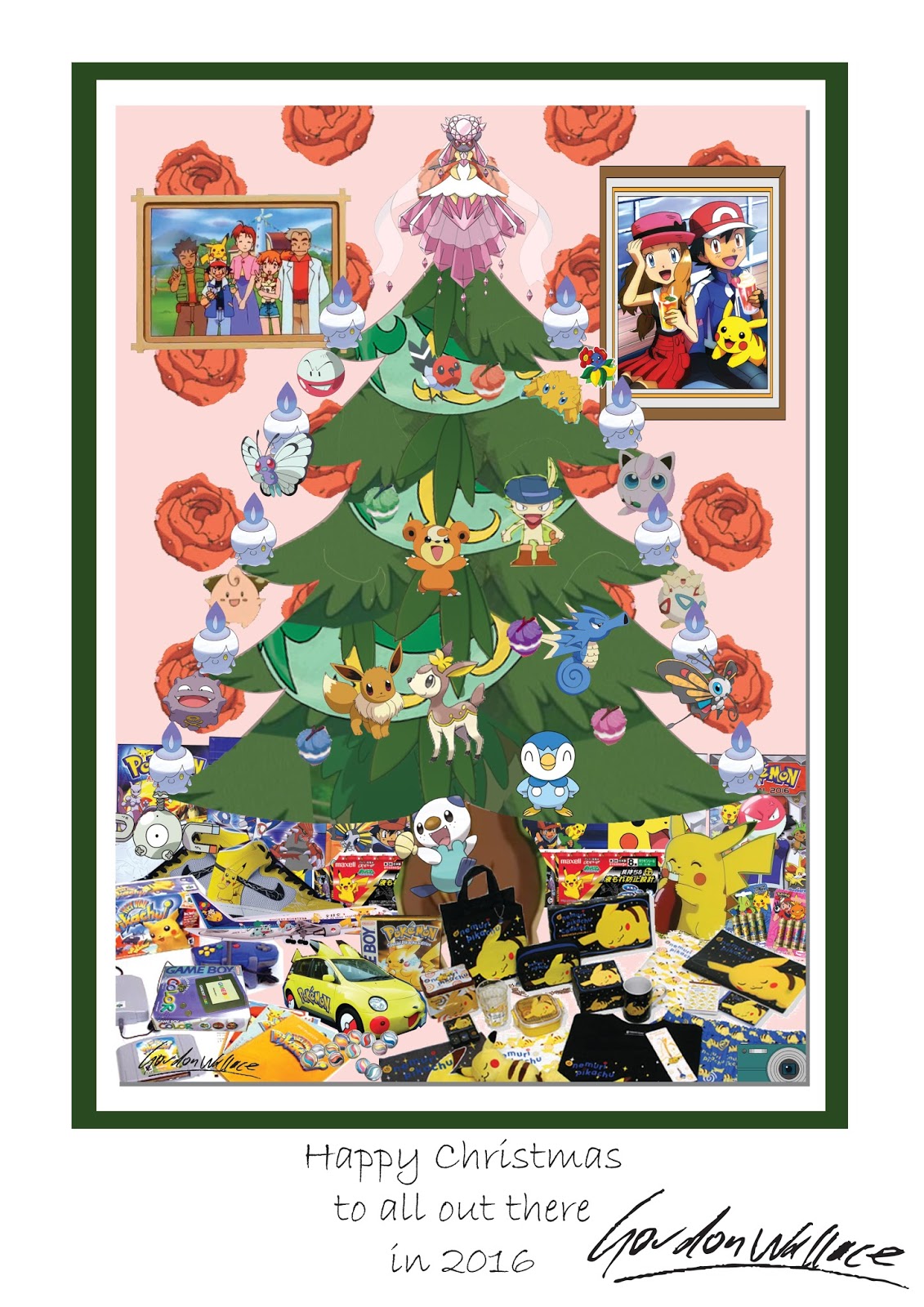
Christmas Card 2016

I admit that recent events in my life kind of intervened in the making of this year's card (I'll explain in a future post). It wasn't until the night of December 22nd I finally had an idea what to do for this year's card. It is something different... a collage, instead of a drawing. Took most of today to make it. Hope you people like it....


Sorry Digimon fans..... and Genwunners.
(But at least I did something for the Pokeshippers.)

Sunday, 11 December 2016

Visual Dictionary of Everyday Things Intervention (Part 1)

The following page-spread is part from a recent creation I have been working on. In October I was visiting a "coffee group" organised by The National Autistic Society. A while earlier I was on a panel choosing the coordinator of these groups and the woman who got the job invited me to take part in one she was overseeing. It was there that I discovered the existence of a comedy club, where people can take turns been a comedian. 

I jumped at the chance and joined. 

It turned out that the plan is to hold a live show at the Scottish Parliament celebrating NAS' 20th anniversary in Scotland. Half a dozen of us (including me) came up with a bit to perform. 

The bit I devised involves the childhood memory of discovering that book of Everyday Things that led to me to take an interest in science, and involves showing the audience the book in question. 

But I did a few modifications to reflect another thing that's celebrating its 20th anniversary (have a guess). And one modification is the page-spread above (replacing the pages covering "batteries").

The version you see at the top was just completed today.

I'll tell more in a later post. Just now events (including this one) are forcing me to delay my progress on "Part 2".

Monday, 28 November 2016

Act of Cultural Vandalism - Animal Farm does Teach Kids to be Nice to Animals

Posted on Facebook earlier today, realting to this story that was trending that day.

This Shilpa Shetty "Animal Farm" thing is just the thing a Cultural Vandal was made for.
The idea she "made a mistake thinking its a book about been kind to animals" is so simplistic and lazy in analysis. To anyone who has read the George Orwell "fairy tale" (including me) one message you'll get is "This is not how to treat a nation of people." In other words, the message of "be nice to others (including animals)" exists in Animal Farm, so Shetty's words are not as "dumb" as you may think.
Also, most kids today reading Animal Farm will not get the Stalin reference. What they will see is a very bad pig mistreating other animals. Kids don't see the world in the same way "cynical" adults (with knowledge of history) do. Most media critics don't realise this when they talk about children's literature (and other things, including cartoons and video games).
I read between the lines, and looking at this story, I see that Shilpa Shetty is a bit smarter than the average twitter user. Books can have multiple messages, from be nice to animals to why Stalin is a bad guy.
#AnimalFarm #ShilpaShetty

Sunday, 20 November 2016

20 Years and we are still trying to catch'em all! - The Greatest Fan Theory Ever

"It all comes together."
While I was locked out of this blog I was not able to work on the Pokémon 20th anniversary special. "Part 1" was originally planned to be finished by 30th April. But that hasn't stopped me doing research, so while I was locked out I was occasionally looking about the internet for various things. And in July I found the most incredible work of art I have ever seen this year - The Pokemon Reset Theory by YouTuber Lockstin.

It is one of the most epic fan theory video I have ever seen. In fact, its THE most epic fan theory video I have ever seen (and that's a rare thing for me to say).

The jist of this theory is that the events of the then upcoming games Pokémon Sun and Moon will feature a plot that'll initiate a "reset" of the Pokémon universe, making it possible for the franchise to have a reboot.

To explain how this would happen Lockstin has delved into the subjects of alchemy, the bible, Hinduism, Norse mythology, the language of flowers ... and more. It is incredible that someone would go such lengths in research to prove a plausible theory about a video game franchise. To me this is not just a series of videos about a "crack-pot theory". It is a genuine work of art (In my sense of the word it is.).

Part 1 (June 2016)

As soon as I saw this video it inspired me. It's ideas made me make a work of art.

But not everyone was convinced by the reboot idea. Why would a franchise making millions of dollars what to reboot it? One noted Pokémon theorist (ProtoMario) created this reaction to that first video, highlighting this....

Pokemon Theory: Sun and Moon IS THE CLIMACTIC ENDING - DEBUNKED?!
(September 2016)

But Lockstin couldn't take that lying down, and reacted to this argument with this video....

Does $$$ Mean No Pokemon Reboot? | Lockstin (September 2016)

It was no stopping him. Soon he was making many videos about and relating to the theory. What I have on this page just the main videos. For the rest, visit Lockstin's channel

Part 2 (August 2016)

Part 2.5 (August 2016)

Part 3 (September 2016)

Part 3.5 (October 2016)

Part 3.8 (November 2016)

And for an encore, in November (when events proved not to be as he predicted) he proved a video that debunked his theory. Talk about meta!


As Pokémon Sun and Moon are about to be released (officially beginning the era of Gen 7) I thought it is a good time to do this post, documenting this piece of fandom history. This theory could only have been theorised in 2016. It was highly dependent on leaked info about the upcoming games. Info that only first came out from February 2016. I love this theory, even if it does prove to be wrong (probably). But I think future fans would love to see this work of art in the future, which is why this post exist. I hope no one forces these videos to go down, because if they do....

I am still working on "Part 2". I originally planned to have all this done by June (until the lockout happened). Because of this (and other events) I have pushed the final deadline for everything to April (to co-inside with the 20th anniversary of the TV anime debut). 

Monday, 31 October 2016

Inktober 2016 - Book Covers

Last year I discovered the Inktober challenge. 

For every day in October participants must...
  1. Make a drawing in ink (you can do a pencil under-drawing if you want).
  2. Post it on your blog (or tumblr, instagram, twitter, facebook, flickr, Pinterest or just pin it on your wall.)
  3. Hashtag it with #inktober and #inktober2016
  4. Repeat
This year's theme came from James, the head of the book club I'm a member of. He suggested book covers of books the club has read. I liked it. I asked him in September to write up a list of 31 books of his choosing for me to do. Not all of them were read by the club (and I have only read one-third of them), but that didn't matter.

Here is the list (including notes and typos).

And here are the covers I have made for Inktober 2016


This one was drawn while I was in Rai Con, so I had a lot of inspiration for this one.


I made a huge mistake in this one. The calendar is supposed to be July, not May (I may have been thinking about my birthday when the mistake was made.)


Sunday, 25 September 2016

Act of Cultural Vandalism - Virtual Reality Comes of Age

Crash Course Games #21 Future of VR (2016)

Recently, the subject of virtual reality had come up to me in two ways.
  1. I have just begun to watch Sword Art Online.
  2. I had my first taste of the real thing recently.
Both these things are an indicator of a massive event in recent tech history - the coming of age of virtual reality. In the past few years VR has become a major subject in tech media, mostly thanks to the Oculus Rift. Starting off as a prototype duct-taped together by a teen in Long Beach, California, it became the subject of a successful Kickstarter campaign in 2012. Two years later the company developing it was bought by Facebook for $2billion. Multiple development kits of it were made for developers to use over the years until this year when a consumer version was finally released ... a year after Oculus helped create the Samsung Gear VR headset

While the Rift is a purpose-built computer interface device (like a head-mounted mouse or Wii controller), the Samsung Gear is basically a smartphone placed inside a pair of goggles. This means that you can make your own VR headset with just a touchscreen smartphone or tablet. All you need is to devise a way to attach it to your face, like a modified welder's mask or scuba/ski goggles. But if you think this "hacking" is too much work, Google has made a piece of cardboard origami that'll save you the hassle plus a few apps you can download on your Android (I presume) to make the most of it. 
And that last one is a clear indicator that there is a high demand for VR in the mid-2010s. Why would Google go through the hassle to make a "cheap" cardboard VR headset if their was no demand for it

You may have worked out (from seeing people wearing the headsets and thinking about them while you play your favourite video game) that the idea of been able to explore another world like you were actually there or becoming someone else in it is an attractive one. Who would want to explore Hogwarts for real and try to learn some magic? Who would want to live in a world where it is possible to have a pet Pikachu that you can cuddle? Who would kill to be the lucky guy with loads of money, in the back seat of an open-top limo with a few .... you get the idea.

It's an idea that is older than you think, and may be as old as fiction. But the technology to make it possible is much older than you think. The make it possible you'll need a way to enclose the senses of the user, like a pair of goggles, and something to replace what those senses usually pick up, like a video on a screen.
According to this criteria, the earliest form of VR was the stereoscope, a 19th century device designed to give a viewer the illusion of depth when viewing specially-made stereographs (a pair of photos taken of the same scene with two cameras placed side-by-side to mimic stereoscopic vision). It's like a steampunk version of the Nintendo Virtual Boy. The stereoscope in some form continued to exist well into the 20th century, mostly in the form of the View-Master. But by then the stereoscope became just a toy. A novelty gift for tourists visiting the Grand Canyon, where they can re-experience seeing it in 3D. And that was the limit of the stereoscope - it only works with still environments, like views of landscapes. 
The next step was to make those images move. One attempt at this was the Sensorama, a coin-operated booth where you can view one of five wide-screen stereoscopic 3D films and hear and smell it like you were there, while riding a rig that tilted you. But this was a mechanical passive system system. For VR to be a reality things had to go electronic.
The true ancestor of the Oculus Rift was a device called "The Sword of Damocles." Created in 1968 by computer graphics pioneer Ivan Sutherland, this contraption is considered by most as the world's first VR headset. Although Philco has a claim of this "first" years earlier, with a headset that controlled a video camera remotely, allowing remote viewing, Sutherland's device get's the credit because of one thing - it can allow you to view computer-generated objects - like a cube (as seen in the clip below). 

demo of "The Sword of Damocles"

It may have been just a wire-frame cube, but it was a start.

The tech remained dormant in research labs and a curiosity in science-fiction until the late-1980s then the cost of headsets fell dramatically, when some realised that they could make cheaper headsets by cannibalising consumer pocket-sized LCD colour TVs. Soon afterword, VR became a hot topic in tech news, as seen in this 1992 episode of Computer Chronicles.

Computer Chronicles - Virtual Reality (1992)

It all seem promising (and familiar). But there was a fundamental problem with this tech that limited its application. Because of the limited processing power that was available at the time, the real-time rendering of realistic-looking scenes was impossible without causing nausea to the headset wearer. 

The environment the user is in is stored and processed by the main computer as a series of co-ordinates in a three-dimension grid and instructions that join up the dots to form shapes and label what colour and texture they are (plus a few other things about the environment, such as its lighting arrangement). For the VR headset wearer to see this environment the computer has to convert all this data into a picture that is to be displayed in the headset. This conversion of data into pictures is known as "rendering" and the more objects and detail a scene has the more processing is needed to render it. Simple scenes, like 1980s TV idents, don't take that much time to render (the processor in the laptop I'm using to write this can do that in minutes, even seconds). But those HD quality graphics you enjoy on 7th gen and later consoles - they take a heck of a lot of processing to render. This is not much of a problem if we are only dealing with still images. But a VR system (and your console) has to render a new image every 50th of a second or so to generate the moving picture you'd expect to see on the screen. Your "modern" console can do this very easily, thanks to their ultra-fast multi-core processors. But computers in the 1990s can only barely manage to render primitive 3D graphics without causing the picture to "stall." This was just an annoying problem if we were just discussing playing games on a console that's plugged into a normal TV set. But in a VR headset this problem had serious consequences. If a picture stalled while the wearer was moving their head, the time lack between the head movement and the system's response to that movement can cause confusion in the wearer's brain, triggering motion sickness.

This is why most VR experiences in the 1990s are of primitively-rendered environments with little detail. Any more detail, the computer could crash or there was a mess on the VR suite's floor.

But despite this, many saw VR then as the future. Cyberpunks saw VR as a means for social change. Former hippies saw it as a legal alternative to LSD. Some believed that with VR you can have your mind leave the physical world by jacking the system up to your brain, Matrix style. You can re-experience memories and share them with others in the same way you can share music on Napster. And if that's possible users would experience a form of enlightenment that was once the reserve of Buddhist monks. But all of that was just cultural hype. Hype that was immortalised in films of the period, like Brainstorm and The Lawnmower Man.

The actually reality of virtual reality was that all those headsets and data gloves were just more expensive versions of the computer mouse. Although it did see some applications, such as the computer-aided design of complicated stuff like buildings and drugs. but to the average Joe VR was just an expensive version of the NES. By the time The Lawnmower Man's squeal was released in 1996 the buzz in the tech world had started to move to the thing that actually changed the world - the internet. A shift this squeal actually captured.

By 2000 VR had become like the Space Shuttle. It was an advanced piece of tech that promised a lot but didn't truly deliver those promises - let. So VR remained in the doldrums.... until something happened ... in the form of Google Street View. 360-degree photography and video revived VR in the 2010s. You no longer needed to render computer-generated scenes live. All you needed was to play a 360-degree video clip to create the illusion of a different world or perspective to the headset wearer. Playing a HD video clip requires less processing than rendering a realistic CGi scene over 50 times a second, as I explained earlier. And that development (and relatively cheaper consumer headsets) has opened the market for VR. So much so that even charities can use it to give shopping mall patrons the experience of having a disability. 

Which brings us to my first experience with VR. 


In March 2016 The National Autistic Society introduced a new campaign, which began with this video.

"Can you make it end?" National Autistic Society (2016)

In June NAS took advantage of recent developments in VR and made an immersive version of the video, where you become the boy with the toy dinosaur. The Autism TMI Virtual Reality Experience has been touring shopping malls across the UK. In September it was Braehead Shopping Centre, in Glasgow. 
Work had begun on a new national newsletter publication I'm working on for NAS's Glasgow office and it was decided that this was a story worth covering for it. So for one afternoon I was their helping putting on the Samsung Gears and headphones and witnessing the various peoples reactions to the experience ... and trying it myself.

The device worked and was simple to operate. When I turned my head, the video moved to reflect this. And with the headphones (and the toy dinosaur in your hands) you are genuinely immersed in the content and you become the boy in the mall. 
So how did the patrons react to this? The comments to this video pretty much summed it up. But one reaction on the day I was there stood out - one woman cried. And (according to the other volunteers at the stall that day) she was not the only one to do so. The number of people who have tried this experience include parents, guardians, teachers, doctors, and psychologists, plus some people who wanted to try the Samsung Gear. And everyone who tried it got a taste of what it was like to be autistic. A volunteer who was with me summed it up like this....
"What would have taken years of text book teaching to describe was understood by the wearer in just a few minutes."
But I know not everyone thinks it is accurate. But that is the nature of autism. It is not the same for everyone! The video is the result of surveying a number of autistic people and what this video shows is what can be considered the "average" autistic experience. Not every autistic person experiences blinding light and/or overwhelming noise in a shopping mall, but many do, especially the very young. That is why many parents tried it. They wanted to have a idea what it was like (no matter how rough or "average" it is). This was clearly an ideal application for VR. And its not limited to autism. It can give anyone the "walk in my shoes" treatment. (I remember that a few years ago VR was used to give users the experience of having a different skin colour to give them the taste of what it was like to be in the receiving end of racism.)

Just two years earlier this tech was muchly experimental. (In 2014, the BBC was experimenting with it to offer 360-degree coverage of the Glasgow Commonwealth Games.) Today, in 2016, its on the verge of becoming everyday, like television was in the 1950s. (In August 2016 they launched the BBC Sport 360 phone app for VR devices for coverage of the Rio Olympics.) In that context, the VR devices of the 1980s and 90s were like the cumbersome TV sets and cameras of the 1930s. Broadcast television then was limited to the electronics available at the time. But thanks to the demand for radar systems during World War II TV improved massively after the conflict ended. (It is said that the main reason why broadcast TV was even allowed to exist then (despite the economic climate at the time) was the powers at be saw it as a means to help speed up the development of radar, but I won't get into that right now.) With surplus CRTs and smaller more reliable valves the costs of TV sets fell to the point that millions could buy one. VR technology in the 1990s was still highly expensive because the processing power needed for them to work was still quite costly. But thanks to Moore's Law and developments in video game console devices and smartphones, the cost of the VR technology has fallen. Like television in the 1950s, VR could became highly widespread in ten years.....

..... but all that depends on whether we want it and some of its current kinks (like the blind person walking problem) get sorted out. Whether the events of Sword Art Online become true in the real version of year 2022 is still out there.