Showing posts with label Design. Show all posts

Monday, 1 March 2021

Drawing logos


Hi everyone. I'm still alive. I have just been busy with the Snacking Otaku. Now that I have published 20 nibbles, I feel that I can now make nibble in a more relaxed pace, allowing time to work on other things. Here's a quick post.

One thing I have been doing recently is drawing logos.

It's to aid the creation of artwork involving branded stuff, like cars or the content of TV screens. Instead of drawing it on the project in question, I can just photoshop one from a personal library.

Here's a selection.


They do look rough .... on purpose. I want to give them a feel that they were made by hand. I could just make proper gifs on illustrator, but they'll look too clean in a drawing.

Also, it makes them useless in counterfeiting. A simple quick glance reveals its handmade origins.

Monday, 23 April 2018

What Makes Computers Tick Project - the dismatling

Recently I have made a major step in the What Makes Computers Tick Project.

The aim of this project is to make a book that explains how computers work in a way everyone can understand. I plan to do this by...
  • Using as little jargon as possible
  • Using tangible mechanical metaphors and diagrams to explain the complex
  • And breaking down the computer into its basic parts
One thing I imagine the many future readers of this book will think about is how does everything I explain relate to the actual thing. In other words, what's actually going on inside all those microchips? No metaphors. Show me what's actually going on. It's like people wanting to see the explosions inside an internal combustion engine

This is the biggest challenge of this project. Computers work using electricity, and electricity is invisible (apart from when you apply too much current or voltage to a device). So a small crash course on the subject will be included in the book. But they still demand seeing actual components at work, so my diagrams will have to look like the actual insides of a computer as possible.

However, they will be some who have never taken a screwdriver to a computer before. Those who have always obeyed the "warranty void" stickers. I know some books have shown the insides of computers before, but have they seen them? Did they do a good job explaining their parts for those who have?

I thought it would be a good idea to actually take apart a computer for those readers..... and I did.


What you'll see above is an old Windows PC my late dad owned in the mid-1990s. Judging from labels on the components it was made in 1995 and was then upgraded in 1997 (it had two hard drives. One 450MB one (which it originally had) and a 3.49GB one that was added later on). I have memories playing games, exploring CD-ROMs and using CorelDRAW 4 and Kid CAD on this very machine. It was buried under some junk when I found it a while ago. (The later Windows PC he bought in 2000 to replace it was thrown into a skip in 2016. I know because I was the one who lifted it to that skip.)

I thought a PC from this vintage would be the ideal choice for dismantling for the readers. This may be due to me seeing computers of this vintage dismantled in books from about the same time...

The inside of an Apple Macintosh IIcx
from DK Dictionary of Science (1994)

But, after thinking about it, a 1990s desktop is ideal for my book. A PC today may be light years away from a 90s desktop, but inside they look very similar. It's like the transmission in a modern car is not that different of that found in a Ford Model T. This would help with one of the main points of my book - all computers (from the 1930s to now) work exactly the same way. They may use different technologies to do some things, like valves or floppy disks, but the principles behind them are the same. 
It was in the 90s when PCs really became mainstream devices, after killing its many rival incompatible systems, leading to today's industry of build-it-yourself PCs. Similar to what happened when the Model T became popular in the 1910s. Ford made a car that was simple, to make it easy to mass-produce, use and maintain. Other cars at the time were too complicated than they should have been, which made most drivers employed chuffers - kind of like the specialists that were once the only people who could use computers. 

The dismantling of the ancient PC was an adventure of curiosity. It was something that showed how willing I am to do research on a subject, if a project requires it. Here's more photos of my research.


Those last two pics were of the PC's CD-ROM drive. Dismantling that drive was a challenge on its own. 

The plan is to turn my observations into a large drawing of a computer's inners, like the one at the top of this post. I've already drawn and mocked up prototypes of the pages featuring this drawing.


The latter one is close to what the final version is going to be like. Note that I include the wires in it and took the components out of the metal casing (the grey rectangle at the bottom).

Since I first told you about this project back in 2016 I have read and watched a lot of research material, made a lot of sketches, and wrote up some text for it.

The dismantling of the old PC this week is the beginning of phase one.

Monday, 17 October 2016

Act of Cultural Vandalism - The Regular Pattern of Nostalgia

Recently, I have been thinking about something about our current culture. We (in the 2010s) are in the mist of a cultural-mining of the 1990s. This has come in many forms, especially in the form of childhood nostalgia. Kids who grew up in the 1990s are now hovering about the age of 30, so its no surprise that many of the things kids of the 90s liked, like Pokemon and Sailor Moon, are experiencing revamps or revivals in recent years. But this cultural mining has also led to the creation of new culture that will become the defining features of our collective culture of the 2010s, mostly in the form of Seapunk and Vaporwave. (How many of you guys have heard of these genres until now?)

All of this has made me think about how we regularly mine the culture of the past. We Westerners have been doing this for centuries. I think this can go back to when the first farming communities began to think back to the days they were hunter-gatherers, before that pesky farming forced them to stay in one place and break their backs harvesting the crop.

But I have noticed a pattern in our attitudes towards the past and its cultural artefacts. And looking at our culture in the past 50 years this pattern has been quite regular. Here's the pattern I have noticed....

  1. A meme (which can be any brand new thing, from a gadget to a work of art) enters our culture. If enough people like it and adopt it it'll thrive. If not, it'll become a fringe meme that only a few fans like. But some of the fringe memes do eventually break out and become "mainstream."
  2. After a while (a few months to a decade) a meme's popularity begins to fall as it becomes "old hat" or "that naff thing we use to like."
  3. After the "naff thing" phase the old meme enters a bit of a renaissance as it enters the "childhood nostalgia" phase. This period can start as early as 10 years after meme's birth, but it usually begins when a meme is 20-30 years old. 
  4. After the "nostalgia" phase ends a meme enters the "curiosity from the past" phase. This is when a new generation discovers the meme and explore it, usually to answer the question "Why was this a thing back then?" This period of a meme's life can happen between 20-50 years after meme's birth.
  5. After the "curiosity" phase comes the most interesting phase in a meme's life. Depending on various things about the meme (it beauty, popularity in the past, association with noted people and so on), a meme can experience a number of forms of cultural appreciation. And this is possible because its during this phase direct examples of it become rarer. This is when things, like furniture and ornaments, start to become "antique." This is the ultimate test for a meme's long-term survival. If a meme proves to be a vital part of its culture of its day it'll last forever. If it proves to be more forward-thinking than it was thought to be back then it'll have some immortality. But if a meme proves to be just a trivial example of its time it may "die" - unless it gets rediscovered by chance and experiences a revival. If a meme proves to be very backward (even if it was very popular in its day) it'll just become a footnote only bought out in history lessons as something to laugh at or as something to scare people into behaving good. In short this is when nostalgia becomes "history" in the big sense of the word.
So that's the pattern I have worked out. But I guess you want examples of this pattern in action.
  • The 1960s style revival - Thanks to TV dramas like Mad Men, the styles of the 1960s have experienced a revival in the past decade. What is interesting is that back in the 1960s (in the UK at least), there was an revival of late-Victorian and Edwardian culture. This was when Art Nouveau was rediscovered and was finally recognised as a pioneering modern design style, proving the pattern I have discovered.
  • American Graffiti - When this movie was released in 1973 it had been a decade since the year it was set (1962). This film is credited for the creation of America's fascination for the 1950s and early-60s, leading to creation of Happy Days and the film adaption of Grease. It was also here when American cars from the 1950s started to become desirable collector's items.
  • 1970s punks who wore Nazi stuff - These teens wore them because they wanted to shock their parents. At the time, World War II was something that happened over 30-35 years ago, so it wasn't something taught as "history" in history class at school let (unlike today). It was something their parents talked about and saw on TV as entertainment. They were not taught the reality of it. Until they were finally taught the facts (leading them to give up wearing them), the swastika was a curious artefact of a time before they were born, not a symbol of racially-motivated mass murder. This generational-divide is exampled by a famous 1978 episode of The Tomorrow People.
  • The Wonder Years - When The Wonder Years first aired in 1988, it was set exactly 20 years ago, beginning with the year 1968. By 1990 it had entered the 1970s, beginning TV's fascination with the decade, paving the way for....
  • That '70s Show - This show lasted eight seasons, compared to its "indirect" spin-off That '80s Show, which only lasted one season in 2002. Why was this? I think one reason it failed was because it was too early for a sitcom set in the 1980s. And I got proof - in the form of a family in Philly called The Goldbergs
  • Curious about past tech - Right now technology from the 1970s and 80s have become curiosities. A prime example of this curiosity can be seen on the Techmoan YouTube channel.
That's all the examples I can think of right now.

Friday, 6 June 2014

Fictional Book #1 Candy, Milk, and Iron by Randall Munroe

Something I look up on the internet regularly is the What if? page on the xkcd web comic site. On this page, xkcd's creator (and former NASA roboticist) Randall Munroe would answer  hypothetical questions sent in by readers in a scientific (plus humorous) way.

Questions and scenarios the site has covered include...
and the classic...
(That last one is a favorite of mine. In this scenario, everyone is transported to Rhode Island (the home of the Griffin family (and everyone else in Family Guy)) and after explaining what happens when they jump, he then explains the chaotic carnage that results when you transport everyone on Earth to the same place. Yelp, Randall thinks of the bits others neglect to think about.)

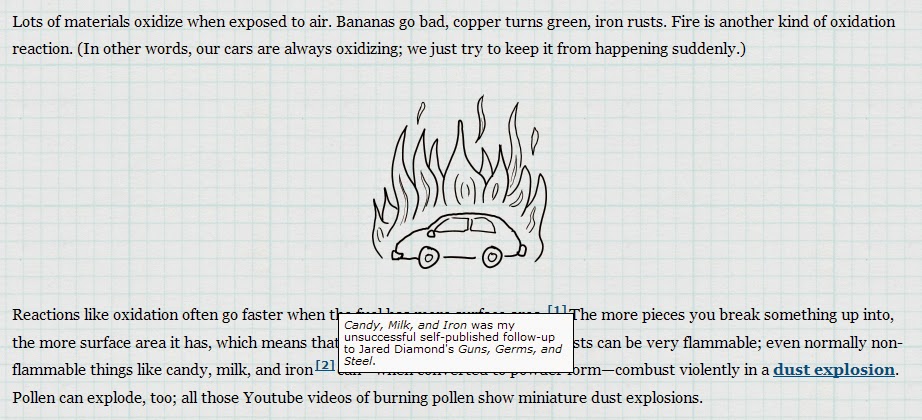
It was while reading one in that went out in May 2014 (What if all the pollen in the sky suddenly ignited?) that I found this text window....

screengrab from What if? page of xkcd (May 2014)

For those who can't make out the text, it says....
"Candy, Milk, and Iron was my unsucessful self-published follow-up to Jared Diamond's Guns, Germs, and Steel."
Guns, Germs, and Steel is a Pulitzer Prize winning non-fiction book by American science polymath Jared Diamond. It was so good that National Geographic produced a documentary based on it in 2005.

It will take me ages to explain in detail what the book is about, but I can sum it up in a way. It is about how a number of factors, from climate and geography to farming and technology, allowed the "civilizations" of Eurasia (plus Africa and the Americas) to become what they are and dominate the "primitive" tribes. The title references three key factors in his argument. The guns represent military superiority through more advanced weapons. The germs represent the diseases that tribes that mastered domestication got exposed to, became immune to, and then (unintentionally most of the time, due to lack of knowledge of bacteria and viruses)  used to wipe out "inferiors." And finally, the steel represents more robust transport systems, such as roads and railways.

(Please note: While writing this I have never read the book or seen the documentary, but I do get (from reading the Wikipedia page) the "jist" of Jared Diamond's argument, as I have done my own research and thinking on history, and I have come to similar conclusions. But please don't take my words as the "final word" on the subject. Look at other arguments too before you decide your own conclusions.
Also, I don't believe in the distinction between "civilizations" and "primitive" tribes. "Civilization" is a word used too much as a term of segregation by people who think themselves as "civilized" and refer to everyone else as "barbarians.")

It's a simple title. A title that (cryptively) describes what it is about. But such a title can be easily abused. Any list of three random things can became a pseudo-title of a similar book... like Candy, Milk and, Iron. With such a book title (which can be open to interpretation) and the huge scope of the original book, its the sort of book you'll imagine someone like Randall Munroe would write (if he wasn't busy drawing stick figurines).

But, if he'd ever try to do so, here's an idea for the cover (this is the reason why this joke picked my interest). Using the most recent cover design of the book as inspiration....

Most recent book cover for Guns, Germs, and Steel 
(still available in most bookshops that sell science books (or Amazon))

Here's my design for Candy, Milk, and Iron....


Its a bit rushed, but this is a proof of concept work. I didn't have access to an x-ray machine so I had to manipulate my photos by inverting them, solarizing them and turning them monochrome. But the effect is similar.

This may be the first of a series of fictional book covers, so watch out for more.....

Wednesday, 12 June 2013

Book Intervention Project - 20th Century Design

I just got an idea for an book intervention project. You may remember (if you had read my previous posts) that a few years ago for university I was asked to "intervene" (vandalize) a book of my own choosing - Inventions That Changed The World.
Today, I just got the idea for my sequel - 20th Century Design by Catherine McDermott from 1998 (1999 reprint) commissioned by the Design Museum, London.


Like the previous book, I scanned every single page of it before hand to make a digital copy for future use. The last one had to have pages glued together as their was no time to do something to them, as the project had a deadline. This one hasn't, so I plan to do something to every page. I already got plans for its many pages so stayed tuned for more.