It's saddened to hear that the great comedic genius that is Robin McLaurin Williams has died. He has gone the same way as David Carradine and Isadora Duncan and joined the choir invisible (though the reasons for their strangling were very different to his).
Before I continue this tribute, I know that some of you may not like the idea of jokes in a tribute of a dead person, but Robin is a comedian form the same school as Monty Python, and (using Graham Chapman's memorial service as a example) it is something Robin would have wanted.
They are a lot of anecdotes about Robin's talent, but the best one I can think of now was this one said back in July by Adam Savage (my doppelganger born 20 years earlier) on his "Still Untitled Project" on Tested.com
Favorite Adaptations - Still Untitled: The Adam Savage Project - 7/01/2014
(The anecdote in question begins on 22:00)
Before I continue (again) I like to say that the movie Bicentennial Man (despite been panned by critics at the time and been a flop in the box office due to (according to Robin) lackluster marketing and a cut in the film's budget by Disney (the owners ofTouchstone Pictures) that resulted in a lowering of quality) is a good film. I think it's better than the original novella (which I have read) as the film includes more emotion.
This is a truly sad loss for me as he has been a big part of my childhood and was responsible for a part of my sense of humour. I saw him as Mork in Mork & Mindy, the Genie in Aladdin, the Adult Peter Pan in Hook, Alan Parriah in Jumanji, the advance aging kid in Jack, and (of course) as Mrs Doubtfire. In my later years marveled his acting talent in films like Dead Poets Societyand Man of the Year.
I would have loved to have met him (alive, of course, but the zombie version of him might be an interesting sight (how it would compare to Bill Murray in Zombieland I don't know until I see it (Them becoming zombies, not the film.))). In fact, back in primary school, me and a friend thought about doing a comic strip adventure about us meeting him. I only drew the first frame of us in the airport introducing the story. Maybe because of that (and the fact my heart wasn't fully into that project (and also it was my final year in primary school)) the project didn't go further and I forgot about it until just now as I am writing this. I can assume that any physical evidence of this project is all gone. Probably put in some shredder years ago to clear out the cupboards in St Lucy's Primary. I wanted to do something involving anthropomorphic animals, but the teacher said we'll do that after the Robin Williams story. Sigh.
So anyway, here is my tribute post to Robin Williams.
Hot Cars Kill Dogs campaign video from Dogs Trust (2014)
I recently found out about this internet campaign from the UK animal welfare charity Dogs Trust (formerly known as the National Canine Defense League). It tackles a problem every person involved n or concerned about animal welfare gets angry about every summer - dogs trapped in cars on sunny days.
They are no actual statistics on how many dogs die in such a preventable way (I tried typing "how many dogs die in hot cars each year" into Google and I got nothing. Not a single number.). But the high school biologist in me knows why it happens. A human could withstand the heat inside a hot car (though some children have died in hot cars (38 a year in the US, according to this website.)). This is because humans sweat. Dogs can't sweat. That is why they stick their tongues out when their exhausted... or hot. The lack of sweat glands can limit their ability to withstand heat. But many humans don't know this fact and assume that a few minutes in a car will be fine because it was fine for them. It's only when they return to a car containing a dead dig that they realize how wrong their assumption was.
What got me seeing this video was how devilishly simple the idea is - a time lapse of a ice sculpture of a dog melting in a car. What struck me was how come no one had thought of this until 2014? Its so obvious. The charity has been around since 1891 (just when cars were beginning to scare horses and running over small animals on the road). Why now? But I guess the dog in hot car problem didn't exist until fully enclosed passenger compartments began to be the norm in the 1920s (before most cars were convertibles). Also, it would have been expensive to set up a time lapse camera (something a charity can't afford to do (until now)).
It is a brilliant idea that illustrates a common problem in the world and I applaud it. But the cinematographer in me sees need for improvement, such as engraving a name on the collar (something in the theme of ice, such as "Frozo") and ending the video with a close-up on the collar showing the dog's name. But please ignore it and not take it as an insult, because they have made something great. It deserves an award of some sort for its simplest and execution. Dogs Trust, I salute to you.
National Council on Problem Gambling ad from Singapore (2014)
On the 13th July the final of the FIFA World Cup in Rio, Brazil took place with an astounding victory for Germany against Argentina. Now, usually I don't take notice of things in the world of sports (I didn't know Andy Murray won Wimbledon until a day after his win). But Germany's victory in the World Cup has had an unexpected effect in Singapore.
For a few weeks Singapore's National Council on Problem Gambling ran an anti-gambling advertising campaign featuring a boy (named Andy) whose dad bet his live savings on whoever wins the World Cup.
So, which team did he bet on?
NCPG ad web banner (2014)
Germany. The team that actually won the World Cup. Andy's dad must have been over the moon by the sudden windfall. Not surprisingly, as soon as people learnt about this ad campaign (with the miracle of hindsight of knowing of Germany's victory) some had altered it to show Andy's Dad minting it and to tell Andy to "stop whining."
For a bit more see this Reuters article and look at a few others as well (I'm not doing all the work for you!).
But what happened to this ad campaign made me ponder. They say that they choose Germany for the ad to add realism to the message. It wouldn't have worked if they made up a team. And it would have worked if Germany had lost, but the NCPG couldn't have had foreseen Germany's luck that year.
So I thought about this idea. Instead of just one ad, the NCPG could have ran two or multiple ads featuring different dads betting on different teams. This will have sorted the unlikely outcome of the dad in the one single ad winning the bet. But then I realized a problem. With multiple dads betting on different teams, viewers will wonder which one would win. Instead of discouraging gambling, this idea will encourage the very thing it was trying to stop. It's like an anti-smoking campaign giving out free cigarettes. Or a drink-driving campaign where people are asked to sample various alcoholic drinks and then asked to drive a car (to a test track, of course).
Hang on. That drink-driving idea could actually be doable. But by using the same technology that makes Testing Britains Worst Drivers: Crash Course possible. If you haven't have seen it, some pretty bad drivers are placed in a telepresence set up that allows them to control a life-size remote-controlled car on a test track like they are actually in it. But after getting use to it they are confronted with their bad driving by another remote controlled car that crashes into them. Its a shocking experience for the driver, so I can imagine my drink-drive campaign working equally well. I could go on about this idea, but I should finish this post with something about gambling.
So here are my thoughts about gambling in general. Looking at human nature and human history, gambling is a natural thing for humans to do. Its a result of our pre-farming/supermarket years of hunting our food. There is no 100% guarantee that you'll eat today, so you had to gamble if that antelope is catchable, as if you didn't, you'll starve. We still have that brain wiring today (though what some of us we hunt now is different, like that Charizard card). So what has hunting got to do with gambling? Think about it. If faced with a African plain for a few hours and you'll see only one small antelope (and your hungry), would you try to get that antelope, or wait a while in the hope of encountering a more fatter antelope with a broken leg? Play safe or take the risk? That's gambling. Taking risks. We take risks all the time, from crossing roads to temporary ignoring speed limits when in a hurry. Although some people will frown upon speed limit breakers and pedestrians who don't use zebra crossings, when gambling involves money and/or doing humiliating things that is when the moral panic lot go mental. They are a lot of stories about people who have become ruined wrecks (financially) as a result of gambling. Most middle class people who read such stories wonder "why do people do this?" Why do people become addicted to gambling? But I'll add this observation. Most of the people you hear about in such stories are neither unemployed or in remedial jobs. Also, if you remember your history, many aristocrats dabbled with a few games of poker. So why mostly them? It's our risk-taking hunter past that is responsible. Gambling has filled a daily need of risk taking that was once satisfied by the daily hunt. Most middle class people are immune to gambling because they have a job that involves risk taking and problem solving, such as stock trading or computer programming (I know that a few of them do gamble, but I'm just rounding off observations.). But if you are in a routine that is unchanging everyday, such as working on an assembly line or (in the case of many aristocrats and unemployed people) doing nothing, you face almost no risk at all. And for the hunter programs in the brain it's boring. The brain craves the frill of taking risks, and that results in those people taking up gambling and, as a result, get addicted. Don't believe me? Ask Desmond Morris. He said this very observation in The Naked Ape.
But here's an additional note of my own. In the past (I'm speculating here.) the problem of gambling addiction was more manageable, as it was a social activity involving friends or rivals. This had the advantage that if you wanted your money back you could beg for it back or (I'll let your imagination fill in this blank). Today, on the other hand, most gambling addicts have their fix using machines. Their honesty and security (for the sake of their owners) makes them more trustworthy, making gamblers more willing to use them. But you can't beg a machine for your money back (and the owners won't like you taking a sledge hammer to their machines).
What I'm saying is that gambling is a human activity and it should involve humans. It should be a social activity, not an isolated one. And it shouldn't be done through machines. A human must be in the mechanism to allow the possibility of begging/cheating, making the game more interesting.
But a more constructive idea would be to find alternative means for the risk craving brain to channel its cravings, such as competing in sports or writing a novel or sitcom in the hope a publisher or producer would like it (we need more writers to end the epidemic of reality TV shows).
If you can think of other suggestions, I'll be welcome to them in comments. And now a final sketch...
This idea was too tempting to do, so here it is to add to the endless pile of anti-smoking ads.
I will be AFKed for a while so don't expect anything new in the next month or so. And don't worry, Cat is still alive and well.
Here's a mini act of cultural vandalism. Last month I purchased and watched the first season of the anime adaptation of Spice and Wolf. What caught my ears was the end credits tune.
End tune of Spice and Wolf season 1 (2008)
When I heard this it reminded me of the song in this episode of Muppet Babies....
(you will need to fast forward it to reach the tune in question).
Muppet Babies season 2 episode 13 "When You Wish Upon a Muppet" (1985)
I first encountered this very episode as a VHS tape during my childhood, so it's a very nostalgic memory that tune revoked.
To save time looking for it, here's the full song with karaoke lyrics.
Ringo Hiyori: The wolf Whistling Song by Rocky Chack (karaoke version)
Please excuse the lack of text, as this is just a quick entry. May be more in future.
Published in 2005 by the South African writer who calls himself "theakapanda," Forever Reborn deals with the concept of human cloning and the lengths upper class hierarchies would take for their name to continue. High brow sci-fi stuff so far. Been a fan fiction it has to involve a beloved franchise or character, and in this story the character in question is.... (drum roll please)
(sigh) Yes, Kai Hiwatari..... the Chris Waddle of this blog. (Its not a reference about his performance in sport, its a reference that he gets mentioned a lot on The Fast Show.) He is the grandson of a rich heartless owner of a multimillion corporation that deals mostly with military hardware and research in cybernetics. Research that has gone well past the line that marks off when a scientific endeavor is borderline ethical (or "morally grey"). In the series, Kai has dabbled into his granddad's "crazy schemes for world domination" as a subject. He didn't become a cyborg (been the boss's grandson) but the rough training (which borderlines to torture) he got in Balkov Abbey made him one of the toughest beybladers (Jeremy Clarkson pause) in the world. As you can tell from this episode in his past, his relationship with his granddad ins't that good. If you have watched the series, like I have (for research purposes), the idea of his granddad cloning him to make a fresh start in insuring his legacy isn't that farfetched.
But, there is another thing about Kai that makes him the ideal character in this story, and its referenced in the title. Kai is the owner of a bit-beast (just click the link. I have incriminated myself too much already in this entry.) that is in the form of a phoenix (the mythical firebird that has the ability to "regenerate" after death, so it'll never die). By been cloned, Kai becomes a sort of metaphoric phoenix. That's enough about the story.
The main reason for my interest in this story is the title, Forever Reborn. Its the sort of title you'll expect to find on a novel that is on sale in an airport bookshop. With that in mind, I think this story needs a book cover worthy of a good novel. A cover that'll look good on the shelves of an airport bookshop. In fact, here's several designs.....
I will make more designs for this book, so please bear with me.
Something I look up on the internet regularly is the What if? page on the xkcd web comic site. On this page, xkcd's creator (and former NASA roboticist) Randall Munroe would answer hypothetical questions sent in by readers in a scientific (plus humorous) way.
Questions and scenarios the site has covered include...
(That last one is a favorite of mine. In this scenario, everyone is transported to Rhode Island (the home of the Griffin family (and everyone else in Family Guy)) and after explaining what happens when they jump, he then explains the chaotic carnage that results when you transport everyone on Earth to the same place. Yelp, Randall thinks of the bits others neglect to think about.)
It will take me ages to explain in detail what the book is about, but I can sum it up in a way. It is about how a number of factors, from climate and geography to farming and technology, allowed the "civilizations" of Eurasia (plus Africa and the Americas) to become what they are and dominate the "primitive" tribes. The title references three key factors in his argument. The guns represent military superiority through more advanced weapons. The germs represent the diseases that tribes that mastered domestication got exposed to, became immune to, and then (unintentionally most of the time, due to lack of knowledge of bacteria and viruses) used to wipe out "inferiors." And finally, the steel represents more robust transport systems, such as roads and railways.
(Please note: While writing this I have never read the book or seen the documentary, but I do get (from reading the Wikipedia page) the "jist" of Jared Diamond's argument, as I have done my own research and thinking on history, and I have come to similar conclusions. But please don't take my words as the "final word" on the subject. Look at other arguments too before you decide your own conclusions.
Also, I don't believe in the distinction between "civilizations" and "primitive" tribes. "Civilization" is a word used too much as a term of segregation by people who think themselves as "civilized" and refer to everyone else as "barbarians.")
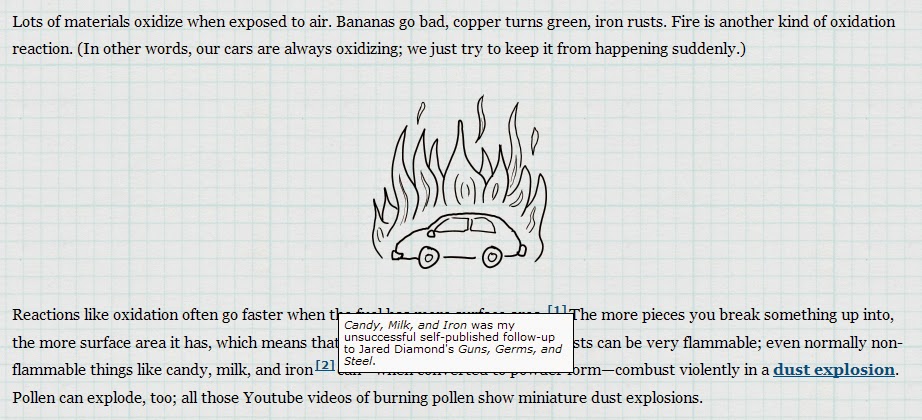
It's a simple title. A title that (cryptively) describes what it is about. But such a title can be easily abused. Any list of three random things can became a pseudo-title of a similar book... like Candy, Milk and, Iron. With such a book title (which can be open to interpretation) and the huge scope of the original book, its the sort of book you'll imagine someone like Randall Munroe would write (if he wasn't busy drawing stick figurines).
But, if he'd ever try to do so, here's an idea for the cover (this is the reason why this joke picked my interest). Using the most recent cover design of the book as inspiration....
Most recent book cover for Guns, Germs, and Steel
(still available in most bookshops that sell science books (or Amazon))
Here's my design for Candy, Milk, and Iron....
Its a bit rushed, but this is a proof of concept work. I didn't have access to an x-ray machine so I had to manipulate my photos by inverting them, solarizing them and turning them monochrome. But the effect is similar.
This may be the first of a series of fictional book covers, so watch out for more.....